At Carlow University, the next generation of ethical leaders is already in the making.
Here, our students gain more than just a degree – they build connections, find purpose, and thrive – working in ways big and small to reshape the future. With your support, we can continue to invest in these future leaders and expand their ability to transform our world.
At Carlow University, the next generation of ethical leaders is already in the making.
Here, our students gain more than just a degree – they build connections, find purpose, and thrive – working in ways big and small to reshape the future. With your support, we can continue to invest in these future leaders and expand their ability to transform our world.
Understand human behavior and create real change: Psychology major
Are you curious about why people behave the way they do? Do you want to learn about factors that lead to racism? Are you interested in understanding mental health challenges how to treat them? As a Psychology major at Carlow, you will gain broad-based knowledge in human behavior and experience from a scientific perspective by exploring research methodology and critical analysis in various fields of psychology, such as counseling, developmental, cognitive, social and biological psychology. In addition, the Psychology program at Carlow offers optional concentrations in counseling, crisis and trauma, and child development for those interested in a deeper dive into those areas of interest.
By the time you graduate from Carlow’s Psychology degree program, you will be ready to enter training in social service and mental health programs in areas such as therapeutic activities, rehabilitation, casework, child care work and service coordination. In addition, the Psychology degree program provides a solid foundation for graduate study in psychology and counseling, and can serve as a path to other careers, such as law, business, education or other fields.
Multiracial group of modern successful positive people discussing startup project and business plan while having meeting at table with laptops and papers
The bachelor’s in Psychology program requires 34 credits in psychology plus 9 credits in supplemental coursework in English and Communication. Psychology coursework includes Introduction to Psychology, Lifespan Development, and upper-level courses in Social Psychology, Cognitive Psychology, Personality Theory, and Biological Bases of Behavior. In addition, you are trained in statistics and research methods via a three-course sequence. A series of “Designing Your Life” courses help you prepare for careers in psychology and beyond, culminating in a senior capstone course that integrates different knowledge you have gained in psychology. A variety of elective courses allow you to explore your own areas of interest, such as Forensic Psychology, Psychology of Women, Abnormal Psychology, and more. You may also opt for an internship experience in a local facility or conduct faculty-led research. In addition, you may choose one or more concentrations in, counseling, crisis and trauma, and child development.
Concentrations
Counseling
This track will acquaint you with pre-professional-level counselor training and professional knowledge and skills needed ot help people in a variety of social service and mental health settings. You will satisfy the regular requirements for the psychology major plus complete at least 12 credits in counseling, such as. Introduction to Counseling, Family Counseling, Substance Abuse Counseling, and more. This concentration cannot currently be completed online.
Child Development
In the Child Development concentration, you will investigate the biological, behavioral, emotional, cognitive and social factors that shape how humans grow and change. This concentration is helpful if you wish to pursue employment or graduate training in developmental psychology, counseling and fields in which additional knowledge of children’s growth and development is helpful. You will satisfy the regular requirements for the psychology major plus complete at least 9 credits in human development, such as Child Psychology, Adolescent Psychology, Children’s Play, Parenting, and more. This concentration can be completed online asynchronously.
Crisis and Trauma
The Crisis and Trauma track will acquaint you with pre-professional-level trauma and crisis counselor training and provide a solid foundation in theory and research pertaining to crisis, abuse and trauma. You’ll focus on crisis assessment, intervention and management and study specific issues such as child abuse prevention and treatment, partner violence and the impact of trauma on individuals and families as well. You will satisfy the regular requirements for the psychology major plus complete at least 12 credits in crisis and trauma, such as Impact of Trauma, Crisis Intervention, Grief and Loss Across the Lifespan, and more. This concentration can be completed online; some classes are offered in an online synchronous format.
Quick facts
Collaborate with faculty on research
Complete an internship at a local facility
Start taking Master’s courses as an undergraduate and earn a graduate degree faster for less money
Alternate degree completion options
Online Degree
Gain the knowledge you need at your convenience with our online degree option. When applying, indicate your interest in the online option.
3-Year Degree
Finish your bachelor’s degree in three years by following a 3-year academic plan. Courses are taken across fall, spring and summer terms with summer courses completely online. When applying, indicate your interest in the 3-Year Degree option.
Accelerated
Fast track your way to a master’s by taking graduate courses as an undergraduate student. Course credits count toward both degrees. Apply for the accelerated option after your sophomore year.
Career opportunities for bachelor’s in Psychology
Jobs you might consider with a bachelor’s in psychology are milieu therapist, career counselor, psychiatric technician, rehabilitation specialist, case manager, university student affairs or admissions counselor. As noted on CareerProfiles.com, these jobs require skills a bachelor’s in psychology provides, such as the ability to evaluate the needs of a client, keep accurate and organized records, express empathy and compassion, and work toward the best interests of clients.
Employment of psychologists is projected to grow 3% from 2019 to 2029, according to the U.S. Bureau of Labor Statistics. Job prospects should be best for those who have a doctoral degree in an applied specialty.
Request that official transcripts from all current and previous institutions you’ve attended are sent directly to the Carlow University Office of Admissions.
Apply
anytime
Start terms:
Fall, Spring & Summer
Psychology faculty
Clara M. Cheng, PhD
Interim Associate Dean of Faculty Professional Development; Director of Undergraduate Psychology Program; Professor
You can expand your perspective with a psychology minor: A better understanding of human behavior and experience can be helpful in any career. This minor, open to any major, allows you to sample from a variety of psychology courses in a general concentration.
Psychology minor curriculum
The minor requires 18 credits, nine of which must be at the 200 level or higher.
Required courses include:
Study Counseling at Carlow
You can gain pre-professional level knowledge and skills for the helping professions such as social work, nursing, education, sociology and human resource with Carlow’s minor in Counseling, open to non-Psychology majors.
Curriculum for Counseling minor
The Counseling minor is open to any major. A minimum of 18 credits is required, at least 9 of which must be taken at Carlow.
Required courses include:
Introduction to Psychology
Introduction to Counseling
6 credits in counseling psychology courses
MA in Psychology and MS in Fraud & Forensics dual degree program
If your undergraduate studies are in psychology, criminology or accounting, you will find Carlow’s dual degree in Psychology and Fraud and Forensics highly relevant. It blends the study of motivation, psychopathy and criminal decision making from the Psychology program with the hands-on investigative skill areas of the Fraud and Forensics program.
Credits required:
48 credits
Cost per credit:
$1,046/credit
Time to degree:
As few as 18 months
Delivery:
On campus, some online
MA in Psychology and MS in Fraud & Forensics dual degree curriculum
The Fraud and Forensics courses focus on financial and cyber-crime investigation, as well as forensic accounting and prevention, detection, investigation and remediation of fraud and white-collar crime. The Psychology courses address personality and developmental differences, and how deviant behavior and beliefs can lead to criminal activities. You’ll study criminal and civil forensic psychology, along with the inherent ethical issues. The dual degree program includes eight courses from Psychology and seven courses from Fraud and Forensics for a total of 46 credits. You must satisfy the requirements of both programs before the degrees are conferred.
Quick facts
Earn two master’s degrees
Understand the motivations, personality traits and environmental influences of criminal behavior
Expand your network with the fraud and forensics cohort model of learning
Multicultural group of students in an auditorium
Career opportunities for MA in Psychology and MS in Fraud and Forensics dual degree
With the dual degree, you will be prepared to work in jobs in the civil and criminal court system, in fraud detection and investigation, and within corporations and government where financial and cyber-crimes are most prevalent.
Many master’s-level graduate students immediately pursue doctoral degrees in related fields. Some Psychology and Fraud and Forensics dual degree students enroll in law school or doctoral programs in psychology or criminology.
Official transcripts from all degree-granting institutions you have attended
Personal essay that describes your academic objectives
Current resume or curriculum vitae
Two letters of recommendation that address your leadership potential and ability to succeed in graduate-level work
An undergraduate GPA of 3.0 or higher is preferred; however, provisional admission is also possible if you do not meet all of the admission criteria but exhibit a strong possibility of academic success.
Apply
anytime
Start terms:
Fall, Spring & Summer
Faculty
Clara M. Cheng, PhD
Interim Associate Dean of Faculty Professional Development; Director of Undergraduate Psychology Program; Professor
Master of Arts (MA) in Psychology: Assessment Psychology concentration
The Assessment Psychology concentration in Carlow’s MA in Psychology (MAP) program will teach you to use the techniques and tools of the field in an array of tasks in primary school and university settings, helping to develop hypotheses about personality, behavior and ability. With an assessment focus, you’ll be able to explore and develop advanced research and clinical skills that will help you find the right career or continue the path to a doctoral degree.
In Grace Library, spanning the third and fourth floor of the University Commons, there are numerous quiet spaces and study rooms for individuals and groups to use.
The Assessment Psychology concentration within the MAP program consists of three courses: Foundations of Neuropsychology, Clinical Assessment of Children, and Trauma Assessment and Intervention. You’ll explore psychological principles applied to educational assessment including learning and behavior theory, strategies for learning and remembering, and problem-solving.
Quick facts
Delve into personality and behavior
Be part of a helping field
Build a foundation fit for doctoral studies
one happy confident young Chinese college student in campus
Alternate degree completion option
Accelerated
Fast track your way into this master’s program by taking graduate courses as a Carlow undergraduate student. Course credits count toward both degrees. Apply for the accelerated option after your sophomore year.
Online Degree
Gain the knowledge you need at your convenience with our online degree option. When applying, indicate your interest in the online option.
Career opportunities for MA in Assessment Psychology
Students within Carlow’s Assessment Psychology concentration are prepared to work in clinical testing environments that use advanced assessment to support diagnoses, create treatment plans, support learning in schools and evaluate cognitive abilities across the life span. A doctoral degree is required in order to become a licensed psychologist.
Official transcripts from all degree-granting institutions you have attended
Personal essay that describes your academic objectives
Current resume or curriculum vitae
Two letters of recommendation from professors or clinical/research supervisors that address your leadership potential and ability to succeed in graduate-level work
An undergraduate GPA of 3.0 or higher is preferred; however, provisional admission is also possible if you do not meet all of the admission criteria but exhibit a strong possibility of academic success.
Apply
anytime
Start terms:
Fall, Spring & Summer
#1
FROM OUR BLOG
Psychology: Benefits of Play Therapy
Child development psychologists work with children, parents, and teachers to apply the principles of play therapy to help kids become capable and independent individuals. Read more about the benefits about play therapy here.
Educational Psychology: How the Pandemic Has Impacted Children’s Mental Health
The damage done to children and adolescents’ mental health during the pandemic will be long-term for those affected. It also will likely shape the field of Educational Psychology for years to come.
The Pandemic Has Brought a New Urgency for Addiction Counseling
As the severity of the COVID-19 pandemic begins to ease, counseling professionals will find that they are needed more than ever before to help those struggling with addiction.
Master of Arts (MA) in Psychology: Educational Psychology concentration
Specializing your MA in Psychology studies with the Educational Psychology concentration, you will learn to use psychology techniques and tools in a broad range of tasks within the primary school and university settings. You can explore and develop advanced research and clinical skills that can aid your pursuit of a doctoral degree or a career in child development and treatment.
The Educational Psychology concentration consists of three courses: Foundations of Educational Psychology, Systems of Educational Practice, and Thinking, Motivation and Creativity.
Quick facts
Prepare for a career in educational settings
Build a foundation fit for doctoral studies
Girl at meeting with psychologist showing his social page on smartphone, talking psychiatrist and child, mental health of children
Alternate degree completion options
Accelerated
Fast track your way into this master’s program by taking graduate courses as a Carlow undergraduate student. Course credits count toward both degrees. Apply for the accelerated option after your sophomore year.
Career opportunities for Educational Psychology concentration
Students within this concentration are prepared to work in clinical testing environments that use advanced assessment to support diagnoses, create treatment plans, support learning in schools and evaluate cognitive abilities across the life span. Students within the educational concentration are often drawn to working with learning and developmental disorders.A doctoral degree is required in order to become a licensed psychologist.
Official transcripts from all degree-granting institutions you have attended
Personal essay that describes your academic objectives
Current resume or curriculum vitae
Two letters of recommendation from professors or clinical/research supervisors that address your leadership potential and ability to succeed in graduate-level work
An undergraduate GPA of 3.0 or higher is preferred; however, provisional admission is also possible if you do not meet all of the admission criteria but exhibit a strong possibility of academic success.
Apply
anytime
Start terms:
Fall, Spring & Summer
#1
FROM OUR BLOG
Educational Psychology: How the Pandemic Has Impacted Children’s Mental Health
The damage done to children and adolescents’ mental health during the pandemic will be long-term for those affected. It also will likely shape the field of Educational Psychology for years to come.
Master of Arts (MA) in Psychology: Exploration Psychology concentration
The Exploration Psychology concentration within Carlow’s Master of Arts in Psychology (MAP) program allows you to take a wider breadth of courses across multiple concentrations and programs. You can define a course of study to fit your unique interests.
You’ll have opportunities to explore and develop advanced research and clinical skills to help in your job search, as well as prepare you for future doctoral studies in psychology.
The Exploration Psychology concentration consists of one foundational course (Neuropsychology, Forensic Psychology or Educational Psychology) and two elective courses of your choice. The electives can be taken through the psychology, professional counseling, education or social work graduate programs.
Quick facts
Design your own curriculum concentration
Earn your master’s in 4 semesters
Build a foundation fit for doctoral studies
Alternate degree completion options
Accelerated
Fast track your way into this master’s program by taking graduate courses as a Carlow undergraduate student. Course credits count toward both degrees. Apply for the accelerated option after your sophomore year.
Online Degree
Gain the knowledge you need at your convenience with our online degree option. When applying, indicate your interest in the online option.
Career opportunities for Master’s in Exploration Psychology
Students who complete this concentration are prepared to work in direct clinical, human services, research and medical agencies. A doctoral degree is required in order to become a licensed psychologist.
Olivia Miller, ’21, biology major and runner on the track & field/cross country team.
We invest in you
Shannon White ’19, who started at Carlow as an adult student, was impressed with the investment that faculty made in her. “I just had very good faculty interactions in the counseling psychology department. They were very personable and willing to help me. They invested in me. We received a good education in social justice which was really important and has made all the difference in the world in the kind of professional I am. Carlow always addresses culture and not everyone does that.”
Official transcripts from all degree-granting institutions you have attended
Personal essay that describes your academic objectives
Current resume or curriculum vitae
Two letters of recommendation from professors or clinical/research supervisors that address your leadership potential and ability to succeed in graduate-level work
An undergraduate GPA of 3.0 or higher is preferred; however, provisional admission is also possible if you do not meet all of the admission criteria but exhibit a strong possibility of academic success.
Apply
anytime
Start terms:
Fall, Spring & Summer
Be prepared for your doctorate or work in the field
Carlow made it simple for Mickenna Ansell ’22 to tailor her education to future goals while she was working full-time. “The faculty and staff were very easy to connect with and I was able to get professional experience in research and clinical practice with their help. My time at the University prepared me to take doctoral-level classes and work in the field of psychology.”
Olivia Miller, ’21, biology major and runner on the track & field/cross country team.
#1
FROM OUR BLOG
Psychology: Benefits of Play Therapy
Child development psychologists work with children, parents, and teachers to apply the principles of play therapy to help kids become capable and independent individuals. Read more about the benefits about play therapy here.
Educational Psychology: How the Pandemic Has Impacted Children’s Mental Health
The damage done to children and adolescents’ mental health during the pandemic will be long-term for those affected. It also will likely shape the field of Educational Psychology for years to come.
The Pandemic Has Brought a New Urgency for Addiction Counseling
As the severity of the COVID-19 pandemic begins to ease, counseling professionals will find that they are needed more than ever before to help those struggling with addiction.
Master of Arts (MA) in Psychology: Forensic Psychology concentration
The Forensic Psychology concentration of Carlow’s Master of Arts in Psychology (MAP) program will help you learn to use the tools of psychology in a wide variety of criminal and civil legal applications. You’ll develop advanced research and clinical skills that can help in the job hunt as well as prepare you for future doctoral studies in psychology.
In Grace Library, spanning the third and fourth floor of the University Commons, there are numerous quiet spaces and study rooms for individuals and groups to use.
The Forensic Psychology degree curriculum focuses on developing research skills through the MAP core subjects and a three-course concentration. Courses include Foundations of Forensic Psychology, Systems of the Criminal Justice System and Psychology of Deviance.
Quick facts
Build a foundation fit for doctoral studies
Earn your master’s in 4 semesters
Make a difference in the criminal justice system
Contemplative female student in optical eyewear for vision correction thoughtful looking away and thinking about idea for essay during time for autodidact, pensive teenager learning on publicity area
Alternate degree option
Accelerated
Fast track your way into this master’s program by taking graduate courses as a Carlow undergraduate student. Course credits count toward both degrees. Apply for the accelerated option after your sophomore year.
Online Degree
Gain the knowledge you need at your convenience with our online degree option. When applying, indicate your interest in the online option.
Career opportunities for Forensic Psychology degree
Forensic psychologists look at people, situations and clues to learn more about criminal motivation and behavior. Together with the core MAP Program curriculum, students within this concentration are prepared to work with civil and criminal courts, juvenile and adult probation, prevention and rehabilitation programs, and corrections.
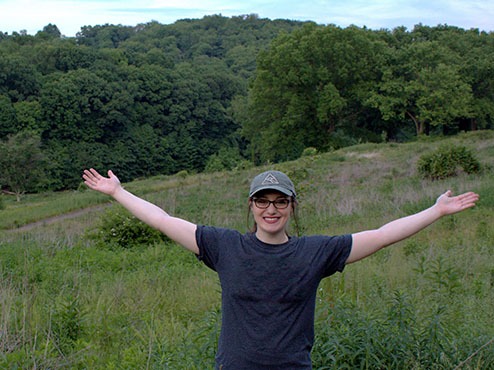
Emily Golling, of Penn Hills, is at the forefront of preserving the green space at the former Churchill Country Club. Golling is an alum of Carlow University.
Make the change.
When a local golf course closed, Emily Golling took the lead in preserving the abandoned land as greenspace for others to enjoy. Her Carlow-instilled initiative took leadership by surprise. “I had no idea about her passion until we were conversing over a planned activity,” said Erin Boyles, assistant dean of students. “I should have known, though, because when she wants or feels something is needed, her passion is front row.”
Official transcripts from all degree-granting institutions you have attended
Personal essay that describes your academic objectives
Current resume or curriculum vitae
Two letters of recommendation from professors or clinical/research supervisors that address your leadership potential and ability to succeed in graduate-level work
An undergraduate GPA of 3.0 or higher is preferred; however, provisional admission is also possible if you do not meet all of the admission criteria but exhibit a strong possibility of academic success.
Apply
anytime
Start terms:
Fall, Spring & Summer
Learn from professionals
What stuck out most for Rachel Seamans ’21 about Carlow’s Master’s of Psychology program was the engaged faculty. “They took an interest in us and made sure we succeeded as both students and people. We weren’t just numbers to them. And, we were learning from professionals who were still practicing, not years removed from working in the field.”
Olivia Miller, ’21, biology major and runner on the track & field/cross country team.
#1
FROM OUR BLOG
Psychology: Benefits of Play Therapy
Child development psychologists work with children, parents, and teachers to apply the principles of play therapy to help kids become capable and independent individuals. Read more about the benefits about play therapy here.
Educational Psychology: How the Pandemic Has Impacted Children’s Mental Health
The damage done to children and adolescents’ mental health during the pandemic will be long-term for those affected. It also will likely shape the field of Educational Psychology for years to come.
The Pandemic Has Brought a New Urgency for Addiction Counseling
As the severity of the COVID-19 pandemic begins to ease, counseling professionals will find that they are needed more than ever before to help those struggling with addiction.
Develop skills to help people: Master’s in addictions counseling
The CACREP-accredited MS in Professional Counseling: Addictions Counseling Track will train you to work with adults and adolescents experiencing one or more addictions (alcohol, prescription drugs or illicit drugs) in a variety of community settings, including addiction/recovery centers, community mental health centers, hospitals and employee assistance programs.
The program is designed to transition you into a career in professional counseling and prepare you to become a licensed professional counselor (LPC) in the state of Pennsylvania.
Additionally, this degree enables you to earn 180 hours of required addiction-specific coursework toward becoming a PA certified Advanced Alcohol and Drug Counselor (CAADC).
In Grace Library, spanning the third and fourth floor of the University Commons, there are numerous quiet spaces and study rooms for individuals and groups to use.
Credits required:
60 credits
Cost per credit:
$1,046/credit
Time to degree:
2.5 – 3.5 years
Delivery:
On campus
Scholarship Information
The Addiction Counseling Workforce Impact Project (AC-WIP) is designed to increase the number of master’s level Professional Counselors who specialize and are certified in Addictions Counseling to serve the citizens of Pennsylvania while increasing the awareness and education of community members and professionals. Students enrolled the MS Professional Counseling degree program are eligible for up to $27,600 in scholarship funding and $4,400 in stipends.
AC-WIP Students will participate in:
Addiction-Related Trainings
Trainings for Community Members in Urban and Rural Communities
NAADAC Certificate Program
AC-WIP Addiction Counseling Symposium
Additional funding available for professional memberships and NCE exam
The 60-credit M.S. degree in Professional Counseling consists of 51 credits of core courses, 9 credits of Addictions Counseling electives, and 700+ clinical hours in Addictions Counseling.
PRC739 – Substance Abuse Counseling Theories & Interventions PRC 741 – The Biological Bases of Alcohol & Other Drug Addiction PRC 743 – Co-Occurring Disorders: Counseling Clients with Substance Abuse & Psychiatric Disorders
Meet educational requirements for Pennsylvania licensure in professional counseling (LPC), national counselor certification (NCC), and the PA certified Advanced Alcohol and Drug Counselor (CAADC)
Accumulate 180 hours of addiction-specific coursework needed for Advanced Alcohol and Drug Counselor (CAADC) certification
Degree program centered around multicultural and social justice
Scholarships and Graduate Assistantships Available
Clinical Fieldwork Experience
“Professional practice, which includes practicum and internship, provides for the application of theory and the development of counseling skills under supervision. These experiences will provide opportunities for students to counsel clients who represent the ethnic and demographic diversity of their community.” – 2016 CACREP Standards: Section 3
During the practicum and internship experience, you will learn and practice, under supervision, a wide array of duties and responsibilities of a professional counselor who is employed at the site placement. These experiences are developmental in nature, as you grow in your competence, skills, and progress from practicum to internship experiences. Over the course of the clinical fieldwork experiences, you will complete a minimum of 700 clinical hours in Addictions Counseling.
Accelerated Masters of Professional Counseling Program
Accelerated
Fast track your way into this master’s program by taking graduate courses as a Carlow undergraduate student. Course credits count toward both degrees. If you are interested in becoming a professional counselor and you are currently a junior or senior, with a minimum of a 3.0 GPA, consider applying for the Accelerated Masters of Professional Counseling Program. You will be able to take up to four (4) graduate level courses which are held on-campus.
Graduate Course PRC 708 Ethics and Professional Orientation PRC 701 Human Growth and Lifespan Development PRC 702 Social and Cultural Foundations PRC 710 Counseling Theories
Accelerated Program – Undergraduate Prerequisite Courses 1) PY 122 Lifespan 2) PY 203 Personality Theory 3) PY 285 Intro to Counseling 4) Any additional 3 credits UG Psychology Course(s)
Contact your Carlow Faculty Advisor for details.
Career opportunities for Addiction Counselors
Employment of substance abuse and mental health counselors is projected to grow 25% from 2019 to 2029, according to the U.S. Bureau of Labor Statistics.
The Council for Accreditation of Counseling and Related Educational Programs (CACREP), a specialized accrediting body recognized by the Council for Higher Education Accreditation (CHEA), has granted accreditation to the following programs in the Department of Psychology, Counseling, and Criminology at Carlow University: Addictions Counseling and Clinical Mental Health Counseling through 2029.
The Professional Counseling Program emphasizes high standards of professional competence. The program is committed to its stated mission through ongoing accreditations by the Middle States Commission on Higher Education and the Council for Accreditation of Counseling and Related Educational Programs (CACREP). We emphasize ethical practice and keep current with state and national standards for certification and licensure for practice in clinical practice environments. In addition, we engage in ongoing program development and refinement based on accrediting bodies’ and licensure boards’ developments and recommendations, as well as sensitivity to licensure requirements, and legal and ethical issues.
Additional program information:
Learn about the program (program description, annual report, mission statements and program objectives)
If you are interested in pursuing a career in Professional Counseling by providing individual and group counseling, you can apply for free online. The graduate program admissions process happens on a rolling basis. Our students have undergraduate degrees in a wide array of disciplines from psychology, human services, social work, or other related majors to majors outside of the helping professions.
Applyby
November 1 or April 1
Start terms:
Fall & Spring
Requirements
Baccalaureate degree from an accredited institution
Cumulative GPA of 3.0 or higher. A GPA below 3.0 may be reviewed on a case-by-case basis if there is relevant evidence of work history in the helping field, and/or strong grades in upper-level courses (psychology, human services, social work, or other related majors).
Evidence of work and/or volunteer experience in a helping field
Evidence of graduate level writing skills necessary for success in a graduate program
Ability to perform all the program’s essential standards required to practice as a professional counselor
Ability to demonstrate professional dispositions and behaviors
Process
Official transcripts from all degree-granting institutions you have attended. Transcripts must be sent directly to the Carlow from the institution(s).
A written professional essay describing your professional career goals, strengths, and skills that will contribute to your success in a graduate counseling program. Additionally, discuss how you incorporate social justice and diversity in your work. If your GPAs is below 3.0, also include the factors that impacted your GPA. The essay must demonstrate evidence of graduate level writing skills. (2-page limit).
Current resume or curriculum vitae highlighting education and professional experiences in counseling and/or related field.
Two letters of recommendation (one from faculty member/academic source & one from employer/volunteer supervisor) that address your professional accomplishments, leadership potential, and ability to succeed in graduate-level work. The references should not be related to the applicant.
GRE/GMAT scores are not required for admission
Transfer students can transfer up to 9 credits earned at a CACREP-accredited program. International students can find more information on our International Admissions page.
The Professional Counseling Program’s application deadline for Fall semester is April 1st and November 1st for the Spring semester. We will continue to accept applications for review beyond those deadlines; however, preference will be given to those that applied by the designed deadlines. The preferred deadline for full consideration of graduate assistantship opportunities is February 1st.
Once your completed application is received, the program faculty will review your application materials and the selected applicants will be scheduled for an interview. Incomplete applications will not be reviewed. Admission decisions include regular, provisional, and conditional admission to the program.
#1
FROM OUR BLOG
The Pandemic Has Brought a New Urgency for Addiction Counseling
As the severity of the COVID-19 pandemic begins to ease, counseling professionals will find that they are needed more than ever before to help those struggling with addiction.
Develop skills to help people: Master’s in mental health counseling
The CACREP-accredited MS in Professional Counseling: Clinical Mental Health Counseling Track is designed to transition you into a career in professional counseling and prepare you to become a licensed professional counselor (LPC) in the state of Pennsylvania. The Clinical Mental Health Counseling track will train you to work with children, adults, and families in diverse settings such as schools, hospitals, correctional facilities, and mental health agencies. The program cultivates respect for the uniqueness of individuals and is grounded in social justice and advocacy. It emphasizes a developmental focus across the lifespan and applies scholarship to clinical practice.
African man counselor therapist coach psychologist speak at group counseling therapy session concept encourage support patients in addiction talk share problem sit in circle in rehab, close up view
The 60-credit M.S. degree in Professional Counseling consists of 51 credits of core courses, 9 credits of electives geared towards your professional interests, and 700+ clinical hours in counseling. You will tailor your degree by choosing a clinical mental health concentration:
Adult Counseling Concentration
The Adult concentration enhances counseling skills and knowledge needed to support adults in various stages of life while gaining insights into the unique psychological, emotional, and developmental needs of adults and older adults.
PRC 718 – Advanced Counseling Skills PRC 732 – Human Sexuality Elective in Counseling, psychology, or social work
Child & Adolescent Counseling Concentration:
The Child and Adolescent concentration is designed for students who wish to work with children and adolescents in a variety of settings: community mental health agencies, school-based mental health counseling, family-based counseling, residential treatment centers, integrative pediatric care, and outpatient counseling. Students will specialize in child-based interventions and get an advanced understanding of assessment and play therapy. Students will also develop an advanced understanding of systemic advocacy and parent consultation to support the development of children and adolescents in their natural environments.
PRC725 – Interventions with Children PRC749 – Play Therapy PYM750 – Clinical Assessment of Children and Adolescents or ED 766 Children and the Media
Or School-Based Mental Health Concentration (graduates with 63 credits)
PRC 725 Interventions with Children PRC 749 Play Therapy PYM 750 Clinical Assessment of Children and Adolescents or ED 766 Children and the Media PRC 751 School-Based Mental Health Counseling Field Experience
*Scholarships are available for the School-Based Mental Health Concentration.
Clinical Evaluation Concentration
The Clinical Evaluation concentration offers an opportunity to develop skills in assessing and diagnosing mental health disorders, conducting comprehensive assessments, interpreting diagnostic criteria, and formulating evidence-based treatment plans, providing essential support to individuals seeking mental health treatment.
PYM740 – Trauma Assessment & Intervention PYM750 – Clinical Assessment of Children Elective in Counseling, psychology, or social work
Corrections Counseling Concentration
The Corrections concentration involves understanding the complexities of the correctional environment, including the unique psychological and behavioral needs of incarcerated and formerly incarcerated individuals. This concentration focuses on gaining foundational training and skills to work with individuals in the criminal justice system while promoting positive change and reducing recidivism rates.
PYM720 – Foundations of Forensic Psychology or PYM723 – Poverty, Race, Gender in Criminal Justice PYM721 – Systems of Crime and Justice PYM722 – Psychology of Deviance
Trauma-Informed Counseling Concentration
The Trauma-Informed concentration involves gaining an awareness of the pervasive impact of trauma on life experiences and relationships in addition to recognizing trauma’s role in the thoughts, feelings, and worldview of individuals who have experienced trauma.
PRC 718 – Advanced Counseling Skills PRC 719 – Advanced Crisis Management Trauma-specific elective in Counseling, psychology, or social work
Generalist Concentration
The Generalist concentration is designed as a comprehensive approach to counseling for individuals passionate about making a difference in diverse communities and prepares students for a wide range of professional opportunities. Students can learn more about these programs by speaking with their Faculty Advisor.
9-credits of electives
The child and adolescent concentration for the Clinical Mental Health Counseling degree includes three courses that address specific interventions, assessment and play therapy. If you choose to concentrate on those who have suffered chronic and/or acute trauma in their lives, you’ll receive training in crisis management, trauma assessment and interventions. You can choose the forensic concentration if you want to work in legal or correctional settings, studying the interaction of mental health with the justice system, the roles of practitioners in the legal system and the unique concerns of this population.
Meet educational requirements for Pennsylvania licensure in professional counseling (LPC) and national counselor certification (NCC)
Degree program centered around multicultural and social justice
Scholarships and Graduate Assistantships Available
African man counselor therapist coach psychologist speak at group counseling therapy session concept encourage support patients in addiction talk share problem sit in circle in rehab, close up view
Clinical Fieldwork Experience
“Professional practice, which includes practicum and internship, provides for the application of theory and the development of counseling skills under supervision. These experiences will provide opportunities for students to counsel clients who represent the ethnic and demographic diversity of their community.” – 2016 CACREP Standards: Section 3
During the practicum and internship experience, you will learn and practice, under supervision, a wide array of duties and responsibilities of a professional counselor who is employed at the site placement. These experiences are developmental in nature, as you grow in your competence, skills, and progress from practicum to internship experiences. Over the course of the clinical fieldwork experiences, you will complete a minimum of 700 clinical hours.
Accelerated Masters of Professional Counseling Program
Accelerated
Fast track your way into this master’s program by taking graduate courses as a Carlow undergraduate student. Course credits count toward both degrees. If you are interested in becoming a professional counselor and you are currently a junior or senior, with a minimum of a 3.0 GPA, consider applying for the Accelerated Masters of Professional Counseling Program. You will be able to take up to four (4) graduate level courses which are held on-campus.
Graduate Courses PRC 708 Ethics and Professional Orientation PRC 701 Human Growth and Lifespan Development PRC 702 Social and Cultural Foundations PRC 710 Counseling Theories
Accelerated Program – Undergraduate Prerequisite Courses 1) PY 122 Lifespan 2) PY 203 Personality Theory 3) PY 285 Intro to Counseling 4) Any additional 3 credits UG Psychology Course(s)
Contact your Carlow Faculty Advisor for details.
Career opportunities for mental health counseling degree
You can work in schools, hospitals, correctional facilities, community mental health agencies and private practice. Employment of mental health and substance abuse counselors is projected to grow 25% from 2019 to 2029, according to the U.S. Bureau of Labor Statistics.
The Council for Accreditation of Counseling and Related Educational Programs (CACREP), a specialized accrediting body recognized by the Council for Higher Education Accreditation (CHEA), has granted accreditation to the following programs in the Department of Psychology, Counseling, and Criminology at Carlow University: Addictions Counseling and Clinical Mental Health Counseling through 2029.
The Professional Counseling Program emphasizes high standards of professional competence. The program is committed to its stated mission through ongoing accreditations by the Middle States Commission on Higher Education and the Council for Accreditation of Counseling and Related Educational Programs (CACREP). We emphasize ethical practice and keep current with state and national standards for certification and licensure for practice in clinical practice environments. In addition, we engage in ongoing program development and refinement based on accrediting bodies’ and licensure boards’ developments and recommendations, as well as sensitivity to licensure requirements, and legal and ethical issues.
Additional program information:
Learn about the program (program description, annual report, mission statements and program objectives)
If you are interested in pursuing a career in Professional Counseling by providing individual and group counseling, you can apply for free online. The graduate program admissions process happens on a rolling basis. Our students have undergraduate degrees in a wide array of disciplines from psychology, human services, social work, or other related majors to majors outside of the helping professions.
Applyby
November 1 or April 1
Start terms:
Fall & Spring
Requirements
Baccalaureate degree from an accredited institution
Cumulative GPA of 3.0 or higher. A GPA below 3.0 may be reviewed on a case-by-case basis if there is relevant evidence of work history in the helping field, and/or strong grades in upper-level courses (psychology, human services, social work, or other related majors).
Evidence of work and/or volunteer experience in a helping field
Evidence of graduate level writing skills necessary for success in a graduate program
Ability to perform all the program’s essential standards required to practice as a professional counselor
Ability to demonstrate professional dispositions and behaviors
Process
Official transcripts from all degree-granting institutions you have attended. Transcripts must be sent directly to the Carlow from the institution(s).
A written professional essay describing your professional career goals, strengths, and skills that will contribute to your success in a graduate counseling program. Additionally, discuss how you incorporate social justice and diversity in your work. If your GPAs is below 3.0, also include the factors that impacted your GPA. The essay must demonstrate evidence of graduate level writing skills. (2-page limit).
Current resume or curriculum vitae highlighting education and professional experiences in counseling and/or related field.
Two letters of recommendation (one from faculty member/academic source & one from employer/volunteer supervisor) that address your professional accomplishments, leadership potential, and ability to succeed in graduate-level work. The references should not be related to the applicant.
GRE/GMAT scores are not required for admission
Transfer students can transfer up to 9 credits earned at a CACREP-accredited program. International students can find more information on our International Admissions page.
The Professional Counseling Program’s application deadline for Fall semester is April 1st and November 1st for the Spring semester. We will continue to accept applications for review beyond those deadlines; however, preference will be given to those that applied by the designed deadlines. The preferred deadline for full consideration of graduate assistantship opportunities is February 1st.
Once your completed application is received, the program faculty will review your application materials and the selected applicants will be scheduled for an interview. Incomplete applications will not be reviewed. Admission decisions include regular, provisional, and conditional admission to the program.
Olivia Miller, ’21, biology major and runner on the track & field/cross country team.
Committed to diversity and inclusion
Neal Holmes ’18 said his time at Carlow was a great academic experience that transformed his work and how he sees the world as a human being. “I felt welcomed by the staff and students, and I could feel that there was a strong commitment to diversity and inclusion work in the graduate counseling program. I appreciate the university’s commitment to social justice which is so parallel to my work in the counseling field today.”
Professional Counseling faculty
Clara M. Cheng, PhD
Interim Associate Dean of Faculty Professional Development; Director of Undergraduate Psychology Program; Professor
Carlow University prohibits sex discrimination in any education program or activity that it operates. Individuals may report concerns or questions to the Title IX Coordinator, Jackie smith at jmsmith@carlow.edu or 412-578-6050.