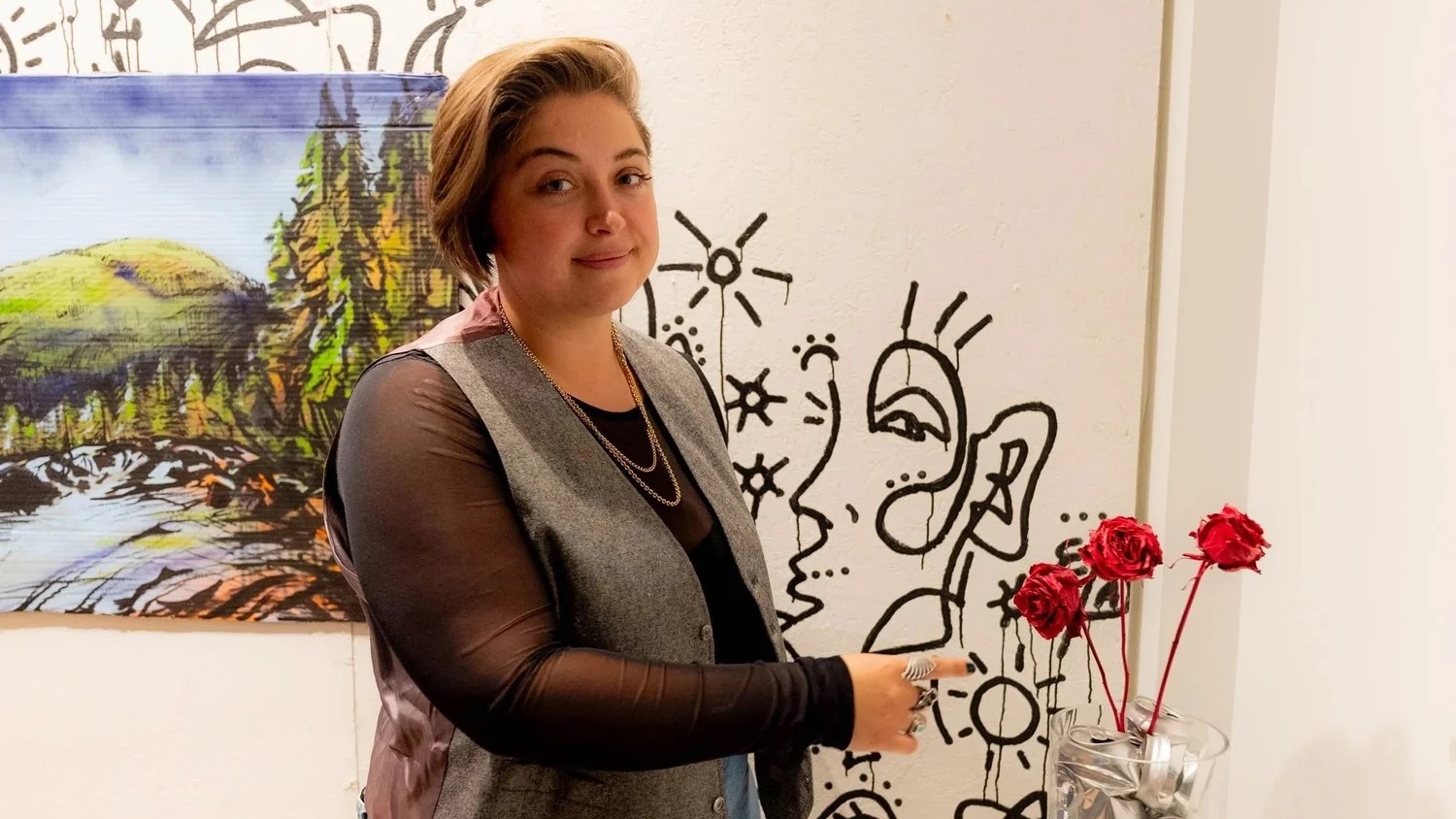
When Emily Paige Armstrong arrived at Carlow University, she thought she had her future figured out. She started as a biology major, driven by a desire to help people and build a meaningful career. But somewhere along the way, another part of herself kept demanding attention: the artist she had been trying to ignore.
“I could not kick this feeling that I wanted to create,” she says.
What followed was a gradual process of learning to trust her instincts. With the support of faculty, classmates, and the creative community she found at Carlow, Emily began building the confidence to pursue art seriously, eventually shifting her focus toward studio art and public murals.
Now, just a few years after graduating in 2020, she is working full-time as a creative, producing murals and large-scale public artwork—often with spray paint—while continuing to explore painting, digital media, and design. Earlier this year, her work was featured in Everything Was Due Yesterday, a Carlow University Art Gallery exhibition showcasing faculty and alumni artists.
“When I was at Carlow, it was a dream to show at the Carlow Gallery,” she says. “The fact that I have a piece in there now feels totally full circle.”
In the conversation below, Emily reflects on creativity, community, trusting intuition, and the path that led her from student athlete and biology major to full-time artist.
What originally brought you to Carlow?
Growing up, my sister and I always knew that we wanted to excel and dream bigger for ourselves. I came from an environment where there were not always a lot of options, so when it came time to think about college, I really tried to be intentional about the kind of experience I wanted.
One of the biggest things for me was community. I knew I wanted a smaller university where I could actually know my professors and feel connected to the people around me. A huge part of that was also that Carlow is women-centered. That was probably the number one thing for me at the time, and honestly, it feels even more important now.
I also wanted to continue playing tennis collegiately, and Carlow gave me the opportunity to do that too. It just felt like a place where I could find my community and really grow into myself.
You originally started as a biology major. What changed?
I came into Carlow as a biology major because I always wanted to help people in some way. I thought maybe that meant medical school or something in healthcare.
But by the time I got to my sophomore year, I could not shake this feeling that I wanted to create. I had always loved art, but I struggled to understand how art could be something meaningful or useful, or how I could actually help people through it.
Then eventually I just hit this point where I was like, “You know what? We’re gonna do what makes you happy.” I decided to add studio art as a major, and honestly that changed everything for me. I started realizing that all the things you are naturally drawn toward are there for a reason. If you actually listen to those instincts, you can build something you never expected for yourself.
How did you become interested in public art and murals?
That interest was always there, even back in high school, but I never really gave myself permission to explore it seriously. Carlow helped create that safe space for experimentation where I could try things and build confidence in my ideas.
One of the biggest moments for me was working on the metal panel installation on the fifth floor of the University Commons. I was one of the student artists who helped create those panels, and looking back now, that was definitely an early push toward public art.
A lot of those opportunities came directly from faculty believing in me and trusting me with real creative work.
What role did the gallery and faculty mentorship play in your experience?
A huge one. My first internship was actually with Sylvia Rhor when she was working in the gallery, and later I worked closely with Amy Bowman-McElhone as well. I just loved being in that environment and learning how artists build careers and creative practices.
Amy especially was incredibly accessible and hands-on. She really allowed me to experiment and take ownership of ideas. During COVID, we were even planning possible student-curated exhibitions before everything changed.
What Carlow gave me was this space where I could try things without feeling afraid to fail. That is so important as a creative person because the world can really undervalue what artists do. You have to build a kind of mental toughness to keep going.
Carlow gave me opportunities to work in galleries, give tours, handle artwork, and experiment with public art. All of that helped me leave feeling confident enough to pursue this professionally.
What did Carlow teach you creatively and personally?
The biggest thing I learned at Carlow was to trust my intuition.
I think, especially as a young creative, there can be a lot of fear around whether pursuing art is realistic or sustainable. For a long time, I felt ashamed of wanting to be an artist because it did not always feel practical. But Carlow helped me understand that you can build a meaningful life doing creative work. You really can.
I also learned how important it is to move through college with intention. Everybody’s path looks different and everybody figures things out on their own timeline, but taking your work seriously and trusting yourself makes a huge difference.
What does it mean to now exhibit in the Carlow gallery as an alum?
When I was at Carlow, it was a dream to show at the Carlow Gallery. The fact that I have a piece in there now feels totally full circle. I also just feel really honored to be included in a show with so many faculty members and alumni artists whose work I respect so deeply.
For this exhibition I created a new large-scale mural installation based on work I originally developed during an artist residency in Costa Rica. I wanted to challenge myself by bringing something unconventional into a fine art gallery space.
What are you working on now?
Right now, I’m working full-time as a creative, which honestly still feels surreal to say out loud.
I do a little bit of everything. Murals and public art are the main focus, but I also work in web design, digital marketing, painting, ceramics, and illustration. As a freelance creative, you kind of have to become a multi-tool.
For a long time I was balancing creative work with day jobs and trying to figure out how to make it sustainable. This year I finally took the leap into doing it full-time, and I really do not want to go back. It’s challenging, but it feels right.
Never miss a story from Carlow University
Follow us on LinkedIn | Subscribe to The Ripple Effect Newsletter | Subscribe to The Human Work on Substack