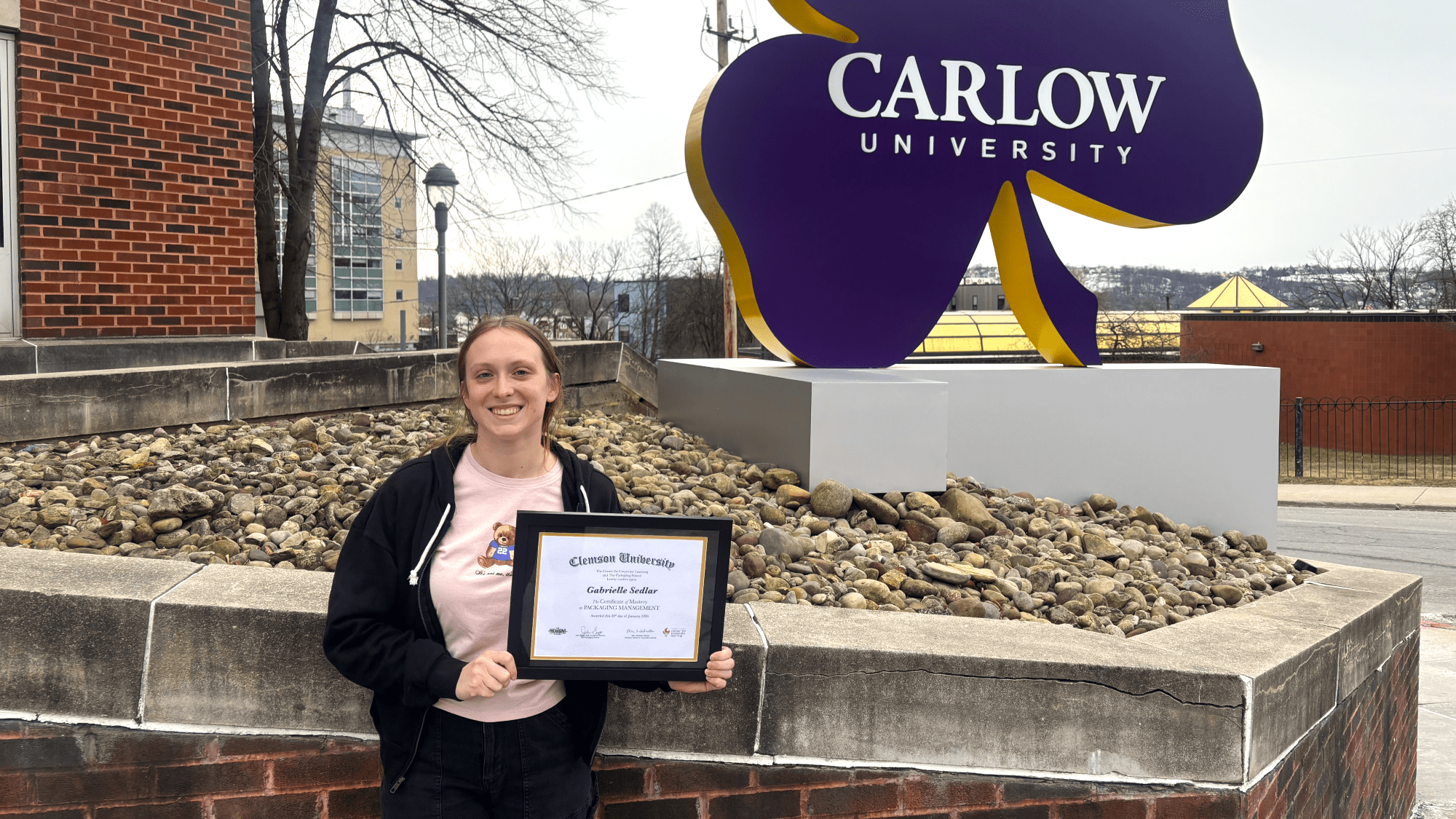
Most people don’t think twice about packaging, until something breaks, leaks, or arrives damaged. For Gabrielle Sedlar, a chemistry major at Carlow University, that everyday frustration became a question worth studying. What materials protect a product? How far does it travel? And what happens to the package once it’s no longer needed?
“It’s not just, ‘put bubble wrap in a box and call it a day,’” Gabi said. “You’re thinking about materials, shipping, safety, and what happens to the package after the product is used. It’s the whole process.”
Before this semester, Gabi didn’t realize packaging science was even a field. She knew packaging design existed, but the idea that scientists helped determine the process hadn’t crossed her mind. That changed when she found herself immersed in a 12-week, industry-led certificate program focused on corrugated packaging and sustainability.
A Conversation That Opened a Door
Gabi’s introduction to packaging science came from Dr. Allison DeLuca, a professor in Carlow’s Computational and Chemical Sciences department who has worked closely with Gabi throughout her time at the University. When Allison learned about a nationally funded certificate program focused on packaging science and sustainability, she immediately saw a connection.
“Allison knew my interests and my background,” Gabi said. “She told me about the program and said, ‘I really think this would be a good fit for you.’”
For Allison, those conversations are central to her approach as an educator. “One of the biggest advantages we have at Carlow is that we really get to know our students,” she said. “Because our classes are small, I can sit down with them and talk about opportunities like this; things they might never be exposed to otherwise. I want them to know there isn’t just one path. There are so many ways a chemistry background can lead to meaningful, interesting work.”
That kind of one-on-one guidance stood out to Gabi, especially when she compared her experience at Carlow to friends attending much larger universities. “I’ve had one-on-one conversations with every single chemistry professor here,” she said. “I have friends at Pitt who never even talk to their professors. Sometimes they only see a TA. At Carlow, you’re seeing your professors every day. They know you.”
Learning Beyond the Lab
The program Gabi entered was the Certificate of Mastery in Packaging Management (CMPM), a 12-week, PhD-led certificate sponsored by the International Corrugated Packaging Foundation and offered through The Packaging School in partnership with Clemson University. The inaugural cohort included just nine students from five universities, representing majors ranging from chemistry and engineering to graphic design and supply chain management.
Unlike a traditional academic course, the program was built around real-world application. Students completed a series of online modules, worked closely with industry mentors, and developed a semester-long Packaging Development Plan designed to mirror the challenges professionals face in the field.
Julie Rice Suggs, who works with The Packaging School and helped guide the program, emphasized that packaging science thrives on interdisciplinary thinking. “Chemistry is such a good fit,” she said. “Understanding how materials behave, how they perform under different conditions, and how sustainability factors into those decisions is critical in packaging.”
For Gabi, the experience quickly expanded her understanding of how her chemistry training could apply outside the lab, connecting scientific principles to logistics, design decisions, and environmental responsibility in ways she hadn’t previously considered.
Designing With Impact in Mind
Rather than focusing on theory alone, the CMPM program asked students to think through the entire lifecycle of a package.
“We started with questions like, ‘What’s the goal of the product?’” Gabi said. “Is it being sold in a store? Shipped directly to a customer? How far is it traveling? Once you answer those questions, everything else follows.”
For her semester-long Packaging Development Plan, Gabi focused on the Lush brand, known for its bath bombs and commitment to environmentally responsible practices. The project pushed her to think beyond the chemistry of the product itself and into the systems surrounding it, like cardboard materials, inks, manufacturing processes, transportation methods, and end-of-life disposal. What was a simple box became a series of interconnected scientific and ethical decisions.
“I’m really interested in environmental science, even though it’s not my major,” Gabi said. “This was a way to connect that interest with chemistry and actually see how it plays out in the real world.”
Reimagining What a Chemistry Degree Can Lead To
For Allison, experiences like this one highlight how flexible and far-reaching a chemistry degree can be, especially when students are encouraged to look beyond traditional pathways.
“There are so many opportunities in chemistry that people don’t always hear about,” she said. “Students might think their options are limited to the lab or academia, but that’s not the case.”
Gabi’s success in the program reinforced that point. She’s currently preparing to present her final project to a board of packaging professionals as part of the program’s capstone experience. After completing the program and graduating from Carlow, she plans to commission into the U.S. Air Force through ROTC, where she’ll serve as an officer before eventually transitioning into a chemistry-related career. While she doesn’t know exactly where that path will lead, packaging is now firmly on her radar.
“This opened my eyes to a career field I didn’t even know existed.”
This is What Innovation Looks Like at Carlow
It isn’t just about advanced labs or cutting-edge tools. Students build connections, find purpose, and thrive in this place where mercy and justice are nurtured alongside technological advancement. Carlow’s annual Day of Giving is Wednesday, March 18th, 2026. When you make a donation, your gifts provide essential support that empowers the next generation of ethical leaders. The amount doesn’t matter, only your commitment to serving others, and the creation of a more just and merciful world.