
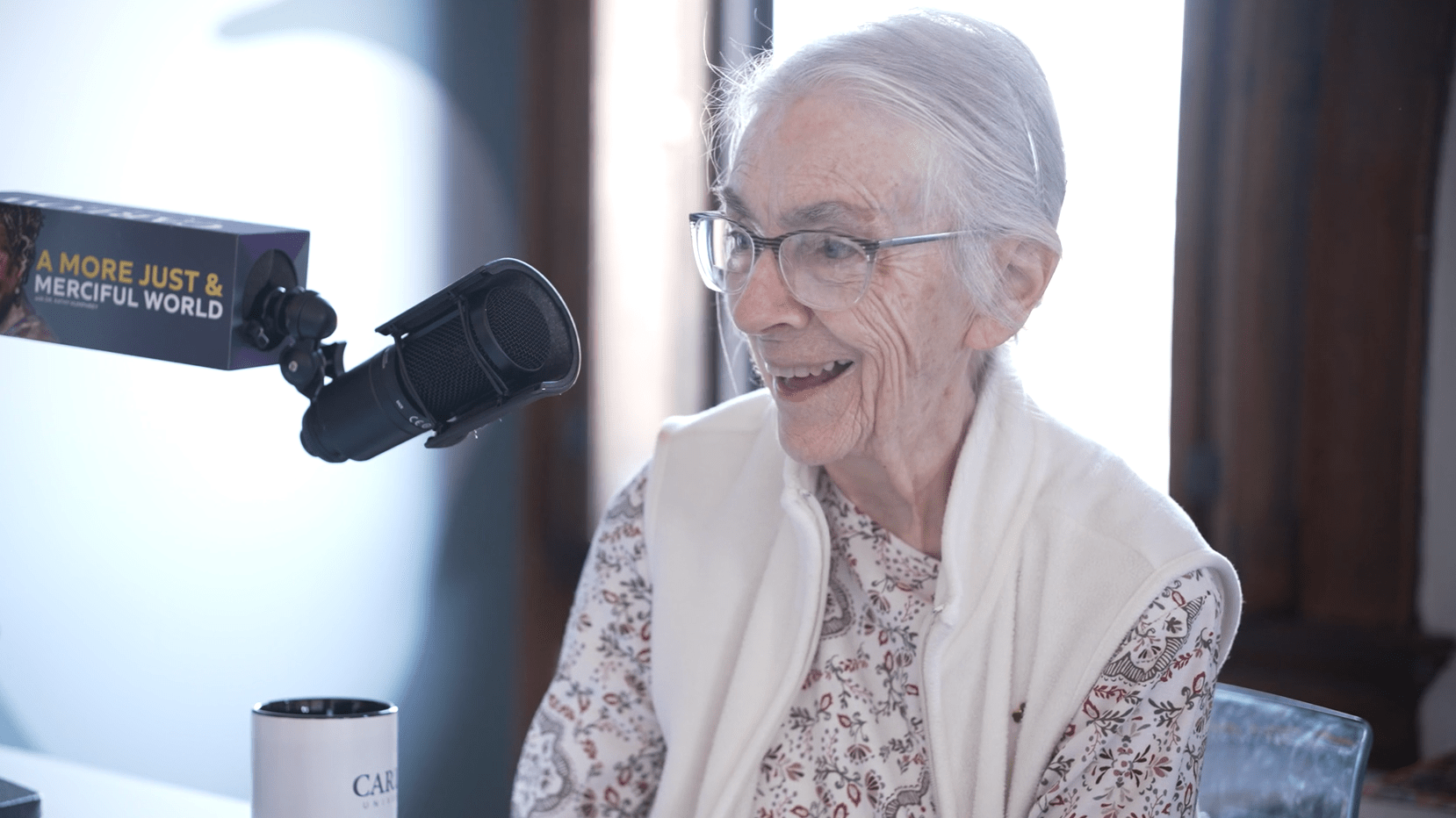
The streets of Montgomery were lined with cars. The men inside glared at young marchers as they made their way toward the church. Sister Pat McCann remembers walking past them, heart pounding, wondering if they were members of the Ku Klux Klan. She and her fellow Sister of Mercy, dressed in full habit, kept moving. Soon the horses came, carrying deputized men with whips, scattering students across porches and alleys. “I didn’t get nervous until we were actually in Montgomery,” she recalled. “I didn’t know if our students were going to be killed.”
That moment more than fifty years ago still shapes how Sister Pat talks about courage, mercy, and the responsibility to stand with others. As a teacher, mentor, and advocate, she has carried the lessons of Selma into classrooms and communities, showing that mercy is strength: the kind that walks into chaos and refuses to turn away.
Teachers and Mentors
Sister Pat traces her vocation to the women who taught her, beginning with Sisters who came each summer to her small Pennsylvania town to teach Bible classes. Their joy and presence left such an impression that she knew even as a child she wanted to live as a sister. Later, at St. Xavier Academy in Latrobe, she was taught by the Sisters of Mercy. One teacher in particular, Mother Jerome, helped her see what it meant to unite academics and compassion.
“She had been a faculty member at Mount Mercy [now Carlow University] and she was retired from teaching… when she came to St. Xavier’s,” Sister Pat recalled. “We were the senior class and she had us for our religion and English classes. She was a magnificent teacher, a magnificent woman, and one of the clear inspirations for me to follow my dreams.”
She has carried that lesson forward. For her, the vocation of a Sister of Mercy has always been about teaching, both in a classroom and by the way she lives her life. The ripple effect of a teacher’s words and example, she insists, is powerful enough to shape a lifetime.
The Face of Injustice
By the time she began teaching history at Carlow and serving as a “dorm mother” in the residence halls, the nation was being reshaped by the civil rights movement. Sister Pat and her colleague Sister DeLellis Laboon received a letter from the Student Nonviolent Coordinating Committee inviting students to join the Selma to Montgomery march. Both sisters knew the risks but decided to go, bringing busloads of Carlow students and others from Pittsburgh.
The journey was harrowing. Police boarded their bus in Birmingham to interrogate the group. Marchers were trained in how to protect themselves if attacked. And in Montgomery, Sister Pat saw firsthand the brutality of deputized men with bullwhips riding through the crowd of young marchers. She remembers the fear of losing track of her students and not knowing if they were safe.
“We all just scattered and ran for porches and tried to take shelter because these horses, these big horses were coming at us,” she said. “That part was so terrible. I had nightmares for weeks after about that because we didn’t know what happened with the students.”
Community and Solidarity
For Sister Pat, the civil rights movement revealed how mercy takes root in relationships. She recalls her own college friendship with a Haitian classmate who spent holidays with her family in Latrobe. That friendship became a personal lens through which she began to understand racism, even before she encountered it directly.
“It was very interesting because in Latrobe, people just couldn’t quite figure that out,” she remembered. “Especially when we went to church on Sunday. You could just feel people wanting to say, where did this person come into their life?”
The Selma march deepened that understanding. She saw students of many backgrounds – Catholic sisters, rabbis, Protestant clergy, white and Black college students – stand shoulder to shoulder in the fight for justice. She saw ordinary families open their doors to strangers, risking their safety to give protection: “The people in that neighborhood in Montgomery, Black families, they just took us in. They made big kettles of soup every day so we would have enough food to eat.”
Lessons for Today
When Sister Pat reflects on the progress made since Selma, she acknowledges both the victories and the persistence of injustice. For her, the lesson is plain. “We clearly have not gotten beyond where we thought we were… with civil rights,” she reflected. “We’ve made progress. But there still is very much sinful racism in our society, and in a lot of good people who don’t even know that it is a sin.”
That is why her recent conversation with Carlow President Dr. Kathy Humphrey resonates. Together, they revisited the teachers, friendships, and acts of courage that shaped Sister Pat’s journey, and considered what those stories can teach us now about stepping into hard places to make a difference; about “walking into the chaos of others.”
Sister Pat’s story opens the second season of A More Just and Merciful World, Carlow University’s podcast dedicated to exploring how people live mercy in the world today. Her voice grounds this new season in lived experience, showing that the new world will be built less by abstract ideas than by the choices we each make every day.