
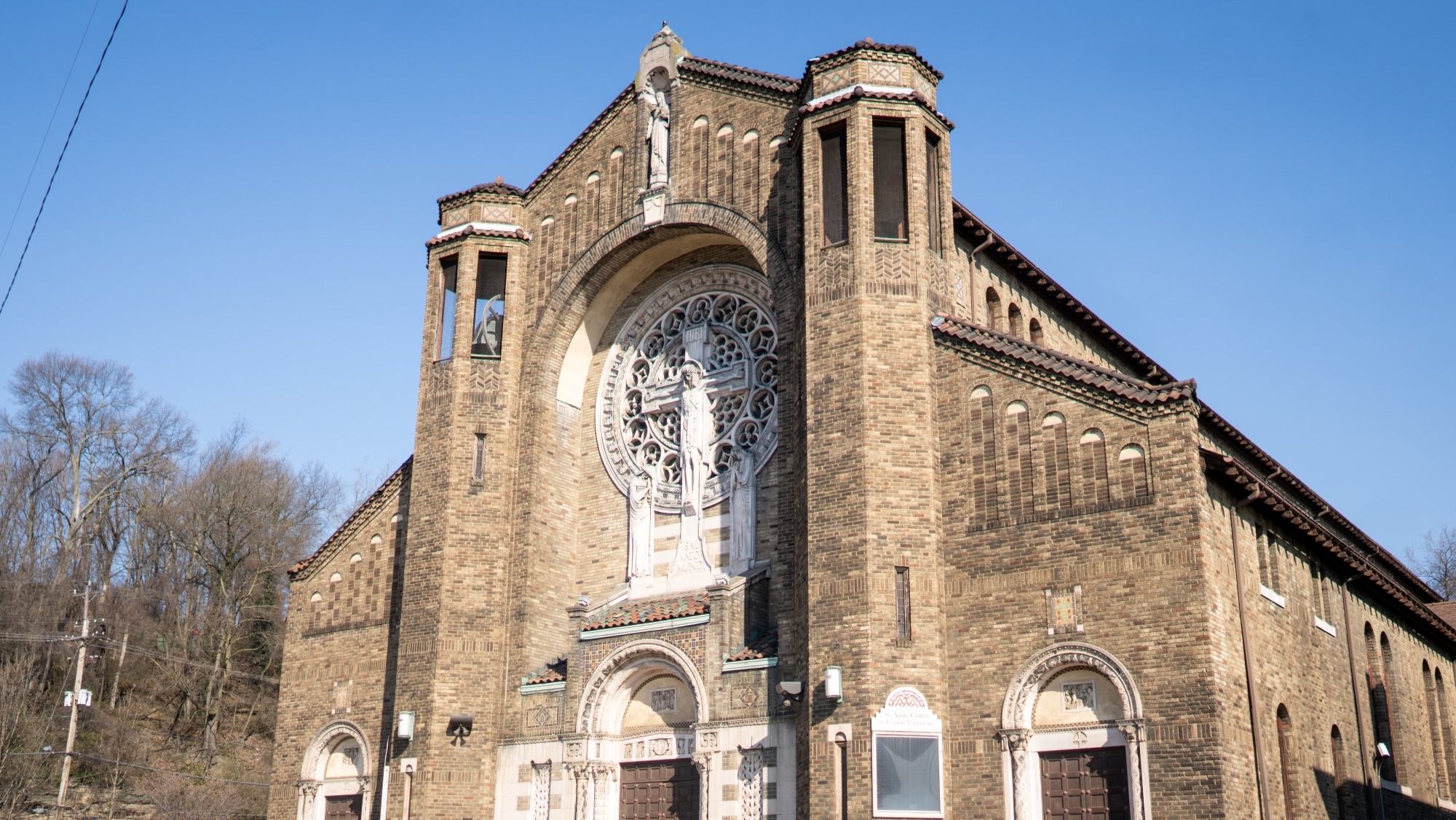
Nearly a century ago, Pittsburgh architect John Theodore Comes died of cancer in his Beechwood Boulevard home at just 49 years of age.
His passion for architecture only exceeded by his deep Catholic faith, Comes blended the two by designing magnificent churches, many of which still stand throughout the United States. Houses of worship all over western Pennsylvania reflect his rigorous aesthetic standards, but the one that may have stayed truest to his vision is part of the Carlow University campus.
Spend time—even just a few minutes—in the St. Agnes Center of Carlow University—formerly St. Agnes Church—and you will find something fascinating.
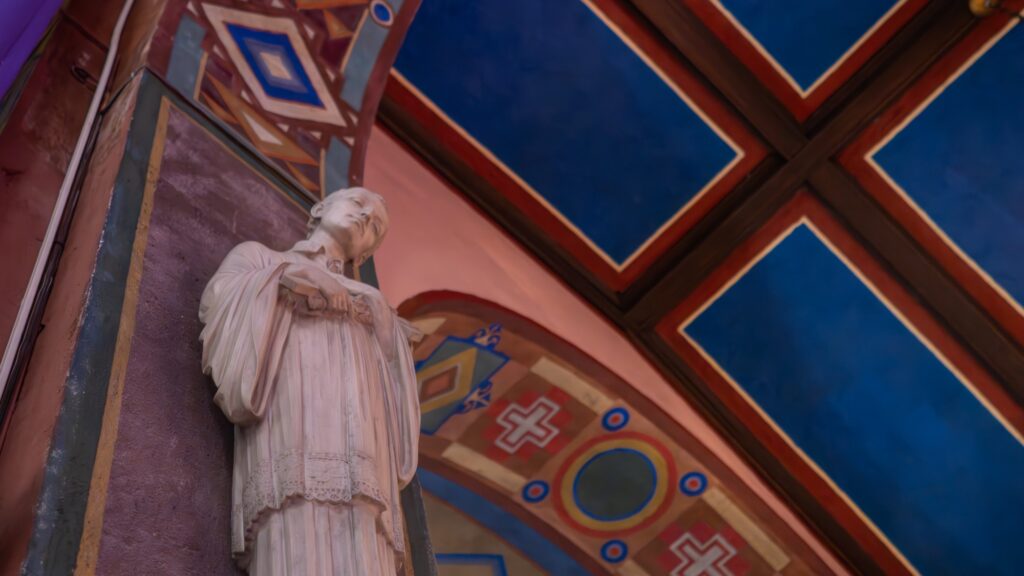
It may be what you are supposed to see: the statues that adorn the sides of the altar, the frescoes of women saints on the ceiling, or the marvelous stained glass windows depicting stories from the Bible.
Those stories in the windows are only the beginning.
“This church was an endless source of food for the imagination,” says Sister Sheila Carney, RSM, who grew up in the parish, and recalls sitting in the pews as a young child listening to Mass and opening her mind and heart to the spirit. “This was the place where the faith took hold.”
St. Agnes was the Carney family’s home parish during Sister Sheila’s childhood until they moved away when she was eight. She returned to the campus—and St. Agnes—as a student at Carlow before religious life called her to various places around the globe. In 2007, Sister Sheila returned in a professional capacity to be the special assistant to the president for Mercy Heritage and Service.
“There is something remarkable about the way this church keeps calling people back,” says Sister Sheila, whose life illustrates this phenomenon as well as anyone’s.
“A Catholic Church must be more than an object of pride for the priest who built it, for the architect who designed it, for the people who paid for it; more than the fruit of love offering for mercies and graces received; it should be all of these, but foremost it must be God’s dwelling, dedicated to the honor and glory of Him who holds our destinies in the hollow of His hand.”
—John Comes, Catholic Art and Architecture [p. 18]
“One of my favorite views of St. Agnes that I remember was coming down Robinson Street when you could see the church in the foreground and the steel mills along the Monongahela River in the distance,” says Maureen Crossen, PhD, a Carlow alumna and now a professor of theology. “I think that speaks to the kind of neighborhood it was—working class.”
Although those steel mills along the Mon are gone, Pittsburgh’s industrial heritage shaped St. Agnes parish. In the nineteenth century, Pittsburgh was a reflection of a rapidly industrializing America that was luring wave after wave of European immigrants with stories of plentiful work and streets paved with gold. By the time the Sisters of Mercy arrived in 1843, downtown Pittsburgh was a thriving urban center surrounded by rural suburbs. Large portions of downtown were destroyed in 1845 by a huge fire, and migration to the suburbs accelerated. Oakland, situated just two miles east of downtown and largely undeveloped, was in a prime location to receive new residents of every socioeconomic class. It did, with the more well-to-do eventually settling in north and east Oakland, while the working class settled in south and west Oakland.
By the 1860s, rail service had encouraged great amounts of residential growth, and by the end of that decade, the Right Reverend Michael Domenec, CM, DD, the second bishop of the Diocese of Pittsburgh, founded St. Agnes parish to serve the residents of West Oakland, Soho, and the Hill District. At the dawn of the twentieth century, Oakland was well on its way to becoming the third largest urban center in Pennsylvania. An article in the October 23, 1904 edition of The Pittsburgh Leader noted that “nearly a score of street car lines pass through [Oakland] which enable one to reach practically every part of the city, including the South Side. Oakland is only twelve minutes’ ride from downtown and 15 from East Liberty. The director believes, however, that in the near future a subway will be constructed, affording Oakland a direct, quick transit line to the downtown section.”
The first St. Agnes Church, dedicated in 1873 and located along Fifth Avenue, was a temporary structure that would be replaced by a more permanent building in 1889. In 1909, the parish purchased two acres of property at the corner of Fifth Avenue and Robinson Street, with the plan to build a new church, school, and rectory. Those plans were expedited when the second St. Agnes Church burned to the ground in 1914.
Most likely, one of the parishioners at that time was the self-taught artist John Kane, whose work “Mt. Mercy Academy” hangs in the A.J. Palumbo Hall of Science and Technology on the Carlow University campus, a gift to Carlow from Elsie and Henry Hillman. The first building on the land that would become the Carlow campus—called “The Chateau” for its large house, is featured high on the hill overlooking Fifth Avenue. Directly below it, and just as prominent, is St. Agnes Church. There’s no date on Kane’s painting, but St. Agnes was dedicated in 1917 and the Chateau burned down in 1923.
“Kane’s painting is a record of the everyday man who saw St. Agnes as part of the community,” says Sylvia Rhor, PhD, an art history professor at Carlow, who is both an admirer of Kane’s work and St. Agnes. “It was a modest neighborhood, but it shows how much a part of the community this magnificent church was.”
It was around this time that a talented architect named John Theodore Comes (pronounced Comb-es) was beginning to establish himself for creating magnificent churches.
“Comes was meticulous in his attention to detail—right down to the altar pieces he designed and his stained glass windows,” says John Wilson, principal of Wilson Architects in Waterbury, Vt. “I saw some drawings he did of a church in Butler, Pa., and he was obviously quite an accomplished artist.”

The idea somehow prevails that art and architecture are luxuries—good enough for those who can afford them, but not necessary in the everyday missionary work of the Church. True art, which is the highest form of appropriateness and order, is not only desirable, but absolutely necessary in the normal life of the Church, and should be found in all buildings from the humblest village chapel to the grandest Cathedral, because God is present in both, and no problem is too small or insignificant to engage the earnest thought of the most talented architect.
—John Comes, Catholic Art and Architecture (pp. 18 and 19)
Comes was born into a family of artisans in La Rochette, Luxembourg, on January 29, 1873. His father, John Richard, was an expert woodcarver, and his father’s twin brother, John Adam, was a builder by trade. The family came to America when Comes was just eight years old. His early education occurred in St. Paul, Minn., but he earned a master of science in architecture from Mt. St. Mary’s in Emmitsburg, Md.
He came to Pittsburgh around 1897, and worked for several architectural firms before beginning his own. With the firm of Kuhn and Russell, he built St. Augustine Church on 37th Street in Lawrenceville. With the firm of Beezer Brothers, he built St. John the Baptist Church—now the Church Brew Works and Restaurant—on Liberty Avenue in Lawrenceville; both of those churches are named Historic Landmarks by Pittsburgh’s History and Landmarks Foundation. At least two of his churches are on the National Historic Registry—St. Fidelis Church in Victoria, Kansas, and St. Luke’s Church in St. Paul, Minn. Comes worked nearly 20 years under his own name before adding two partners—to form the firm of Comes, Perry, and McMullen in 1921—just a year before his death.
“I remember my mother saying that her uncle was an architect who designed churches,” says Betty Mayfield, who never met her great uncle because he died well before she was born. “But I never heard her say too much else about him.”
Maybe it was the distance from the rest of his family—they eventually settled in Arkansas while he lived in Pittsburgh—or maybe because communications back in the late 19th and early 20th centuries were not like they are in today’s world of instant communication. Letters were exchanged, but a thousand miles might as well have been the other side of the world.
Mayfield began to close some of that distance in the past year, which she spent visiting many of the Catholic churches he designed. “This trip did not start out as a pilgrimage,” says Mayfield. “It began as a trip to see churches, but the beauty of his churches soon turned it into a pilgrimage.”
By Mayfield’s count, Comes designed or had a hand in the design of 72 churches, rectories, schools, convents, or other parish buildings. “It was fascinating to me what he had done, and how much he had done,” says Mayfield, who lives in Dickinson, Texas, a town about halfway between Houston and Galveston. “And I am sure I don’t have them all [counted].”
In February 2007, Mayfield traveled to Salt Lake City, Utah—to see the Church of the Madeleine—where Comes was hired by the bishop to oversee decorating the interior. Last summer, she and her husband came to western Pennsylvania where she visited about a dozen churches designed by Comes, including the St. Agnes Center of Carlow University.
“None of them were alike,” she says, agreeing that there was nothing cookie-cutter about his designs. “At St. Agnes, he used a lighter shade of marble for the altar than we saw anywhere else.”
Still, Mayfield readily admits that each of his designs had one thing in common. “Everything he has done in those churches reinforces his devotion to God.”

“One of the fundamental requisites of an art work is that it shall be good, true, and beautiful; if any of the qualities of this trinity are missing, then the work is a failure.”
—John Comes, Catholic Art and Architecture (p. 47)
In the obituary that appeared in the April 13, 1922 edition of The Pittsburgh Sun, Comes was described as a prolific writer for “art publications and ecclesiastical periodicals,” but Catholic Art and Architecture was the only book he ever wrote, and he appears to have done that one as an afterthought. In the foreword, he indicates that the contents were part of an annual lecture about art and architecture that he gave to seminarians, and he only put it into book form at the request of others.
Above all, the book demonstrates Comes’ deep faith in God, and reveals a philosophy of art and architecture that, at times, sounds a little like a football coach exhorting his team not to forget the fundamentals. For him, the fundamentals were beauty, truth, and goodness. For his admirers, those fundamentals coalesce in St. Agnes.
“St. Agnes is such a wonderful, expansive space,” says Rhor. “Light in a religious or educational space creates something present and tangible. The stained glass windows in St. Agnes are beautiful. When the light hits them they are glorious. They don’t make stained glass windows with this process any longer.”
Rhor believes Comes may have been inspired by Abbot Suger, a 12th-century French abbot-statesman-historian who was an influential patron of Gothic architecture, and who saw light as an important metaphor for God.
Nevertheless, as meaningful as light can be as both a metaphor for God and as a way of making a striking space even more beautiful, those windows, which depict many of the stories from scripture, may have played a vital part for the immigrants filling the pews at St. Agnes—a way of connecting with the faith when you think and speak in a different language than the world that surrounds you.
“Many members of the parish may not have understood English or they may have been illiterate,” says Crossen. “The faithful, however, could still look at the windows depicting various Bible stories and follow along.”
The “faithful” seems a particularly apt description of the people of St. Agnes parish, who put their working-class dollars behind the project. According to parish records, they paid $73,500 for the two acres of land that the school and church occupy today. Using the consumer price index as a method of calculating the cost in today’s dollars, that $73,500 amounts to more than $1.7 million today.
“I think a great deal of credit should be given to the people of this parish,” says Sister Sheila. “It was a modest neighborhood, but they didn’t skimp in the building of their church.”

“What do we mean by truth in architecture? We mean that every detail of design and construction must be a true expression of the purpose of the temple, must be sacramental, as it were, conveying an inward or spiritual idea by an outward sign or symbol.”
—John Comes, Catholic Art and Architecture (p. 47)
“How would it affect people who have been working in the mills week long to sit in this church?” muses Sister Cynthia Serjak, RSM. “I think John Comes realized what beauty and authenticity could do for people. It might make them sit a little straighter and sing a little louder.”
Singing a little louder is especially important to Sister Cynthia, who embraces truth and beauty by slightly different measures—she measures them in sheet music. While she appreciates the physical beauty of the architecture, her ultimate test—as a musician—is the sound being produced.
“This building has incredible acoustics,” she says. “There are so many hard, flat surfaces for the sound to reverberate. It didn’t matter whether we were singing on the organ loft or—after Vatican II—when we brought the choir to the front of the church. Twenty women singing would sound like 50.”
Part of the reason for this unsurpassed sound is Comes’ belief in truth in architecture. His choice of materials was much more extensive—Botticino, Italian and other imported marbles for the altar, granite pillars to support the roof, hard wood floors, and intricate stone work combine to make sound resonate throughout the church. He considered using these materials to be too high a price to pay because he felt it might make people question the truth coming from the pulpit.

“We know that the church has the answer to every riddle that perplexes the human mind, and that if her teaching be accepted and applied to all activities of life, the golden days of the 13th century may again return.”
—John Comes, Catholic Art and Architecture (p. 69)
Although one or two eyebrows may rise at Comes’ reference to the 13th century as “golden days,” for gothic architecture, it was the golden days. The engineering skills required to construct such classic gothic features as high arches, stone vaults, or tall towers had been in practice long enough for the artisans of that day to become experts. Construction on the Cathedral of St. Mary of Toledo, Spain, was begun in 1226, the towers of Notre Dame Cathedral in Paris were completed in 1245, and the foundation stone for the Cologne Cathedral was laid in 1248. All over Europe, other churches, both large and small, were in some phase of construction.
In those great cathedrals, it is said, their magnificence is so inspiring that the first time you enter you can’t help but turn your eyes toward heaven. Comes achieved that type of impact with St. Agnes, too.
“I was in awe,” said Mayfield. “It was a revelation to me that there was so much talent in my family.”
Sister Sheila compares entering St. Agnes to the nighttime lights of Pittsburgh that greet motorists coming through the Fort Pitt Tunnels.
“In the vestibule, the ceiling is low, and you have no hint about what’s to come, but when you enter the body of the church, you can’t help but look up,” she says, adding that a special part of that glance are the frescoes that adorn the sanctuary. “You discover as an adult that those frescoes on the ceiling are all women—it was thrilling.”
One might think it highly appropriate for a church ceiling at a women-centered university to be adorned with women saints, but, remember, those saints on that ceiling predate the women-centered university.
As is the custom, the diocesan bishop names any new parish. In St. Agnes’ case, the naming rights fell to Bishop Domenech. Although there is no documentation to determine why he chose St. Agnes, the common practice is that the bishop name a parish for the saint whose feast day it is when approval to open the parish is granted.
The feast day of St. Agnes of Rome—who is the patron saint of girls, among others—is January 21. A second feast day, January 28—which was celebrated until Pope John XXIII revised the calendar—was the day that the present structure was dedicated in 1917, the day before John Comes’ 44th birthday.
The story of St. Agnes is itself a fitting tribute to Carlow. A member of the Roman nobility who was raised in a Christian family, 13-year-old Agnes refused an order from the Roman Prefect Sempronius to marry his son. Angered by the refusal, Sempronius condemned Agnes to death, but Roman law did not permit the execution of virgins. Rather than grant mercy, he ordered her dragged through the streets to a brothel. Tradition says that she remained a virgin until a Roman officer killed her.
Could Comes have known all this when he designed the church? Maybe.
“If there is anyone who would have listened for God’s voice as to what to put on that ceiling, I know it would have been him [Comes],” says Mayfield.
Unfortunately, it may be condemned to be just another riddle without an answer because if Comes had an explanation for why he built the St. Agnes Center in the manner he did, he didn’t communicate it in any of his writings that survive. Of course, no one—least of all a theologian—is ruling out divine intervention.
“Comes is right when he says the church has the answer to every riddle,” says Crossen. “The answer is God.”