
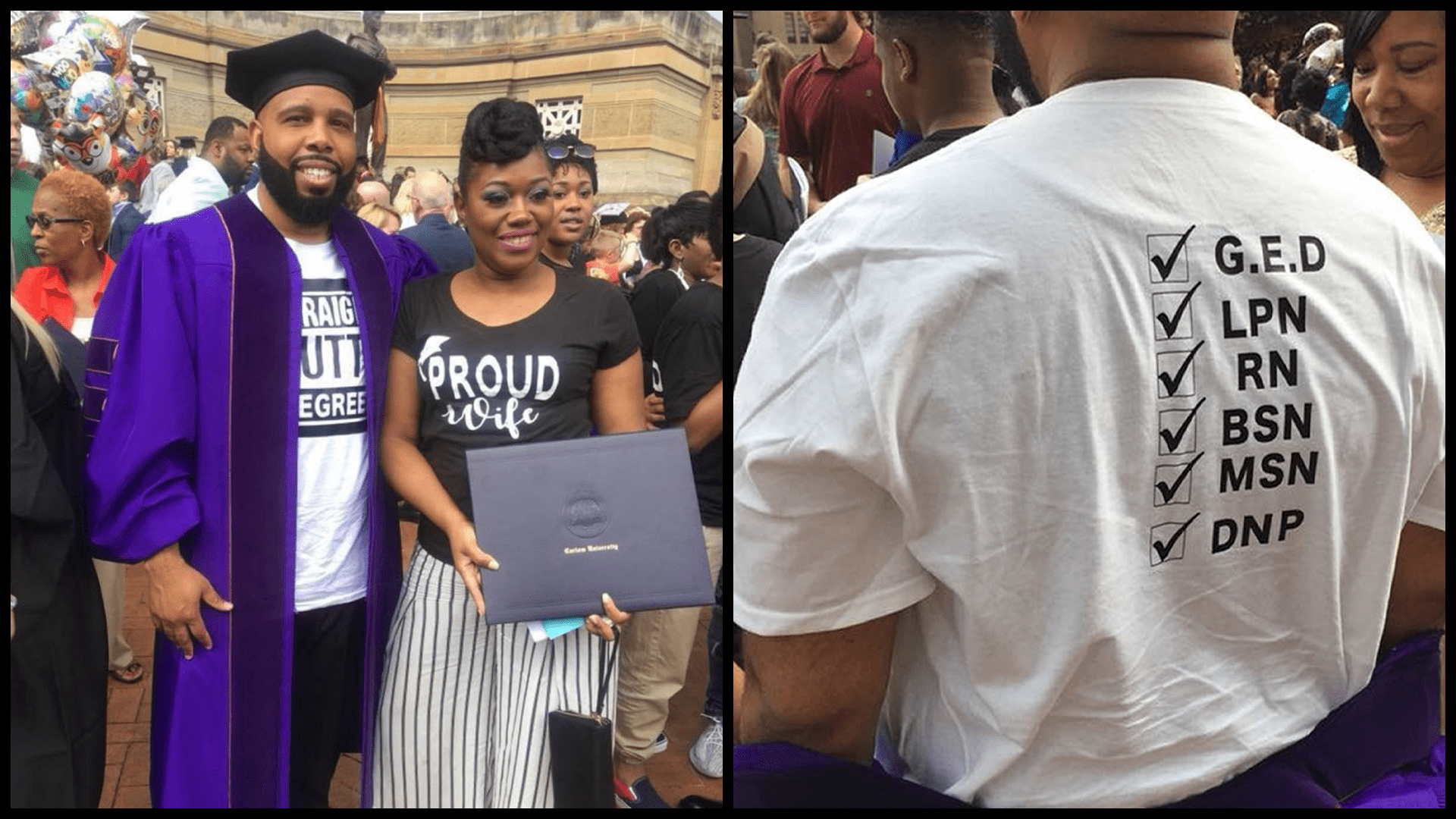
Spend a few minutes talking with Barron Taylor and one thing becomes clear right away: he has a story to tell.
Barron speaks with the kind of enthusiasm that suggests he has thought deeply about Carlow University and what it’s meant in his life. Ask a simple question about his time as a student and the answer quickly becomes something larger: a reflection on resilience, faith, community, and the responsibility to use what you have learned to serve others.
For Barron, Carlow was not simply the place where he earned his degrees. “Carlow University saved my life,” he says. “I felt like I had been adopted into a family. When I showed up to class, I felt like people genuinely wanted to see me succeed.”
Years later, that experience continues to shape the way he thinks about education and leadership. We sat down with Barron to discuss his journey from attending to teaching at Carlow, being the first African American male Doctor of Nursing Practice graduate in the University’s history, and the ways he’s making an impact in his community today.
What first brought you to Carlow?
I lost my job during the recession in 2009. At the time I was serving as a nursing director at a rehab facility in Pittsburgh and also working at UPMC Montefiore. When that job disappeared, I had no idea what I was going to do. We had a mortgage, four kids, and suddenly everything felt uncertain.
My wife had already earned her bachelor’s degree at Carlow and was working on her master’s there. One day she rolled over and said, “Why don’t you go back to school at Carlow?”
My first reaction was disbelief. I thought, how am I supposed to go back to school with no job and a family to support? But I applied, and when I was accepted I remember standing there and just crying. It was overwhelming. Being at a university was something I had only ever dreamed about.
Why did that moment seem so unattainable?
To understand what that moment meant to me, you have to understand where I came from. I grew up in Homestead, Duquesne, and McKeesport. Section 8 housing, food stamps, the projects.
I was taken away from my mother when I was four years old, reunited with her when I was fourteen, and she died when I was seventeen from a combination of substance abuse and cancer. I did not have a father who was present in my life.
In the environment I grew up in, just getting an associate degree felt like the highest level of education I could ever realistically achieve. I became an LPN first and then an RN in 2004, but I never truly believed a university degree was possible for someone like me.
You mentioned that Carlow changed your life. In what way?
One of the most transformative experiences I had at Carlow was actually a theology course, Introduction to the Old Testament. At the time I remember thinking, why do I have to take this? I am here for a nursing degree. But the class ended up changing my life.
We were reading the Book of Hosea, and something about that story spoke directly to my situation. I realized I had made my career and my paycheck my source of identity. When I lost my job, it felt like everything had collapsed.
That class helped me see the moment differently. Sometimes you have to be broken in order to be repositioned for something greater. That realization shifted my entire mindset.
How did the program structure help you balance school, work, and family?
Once I started at Carlow, I did not take the opportunity for granted. I was excited just to be there.
The CAP program was a big reason it worked for me because the courses were condensed into eight week sessions. That allowed me to take multiple classes in a term while still balancing work and family responsibilities.
I started in September of 2009 and completed my RN to BSN by December of 2010. During that time my advisor suggested I take the three Ps, pathophysiology, pharmacology, and physical assessment, at the graduate level so they could count toward a master’s degree later. Once I finished my bachelor’s, it made perfect sense to keep going.
What led you to eventually teach here?
After completing my master’s as a family nurse practitioner in 2012, something unexpected happened. The day of graduation, Dr. Karen Cummins, who directed the Family Nurse Practitioner program, walked up to me and said, “I am here because of students like you. I want you teaching here.”
She saw something in me that I did not fully see in myself yet. About a year later, after gaining clinical experience, I started teaching as an adjunct faculty member in the graduate nursing program at Carlow. Being able to teach students the same way my professors had taught me was incredibly meaningful.
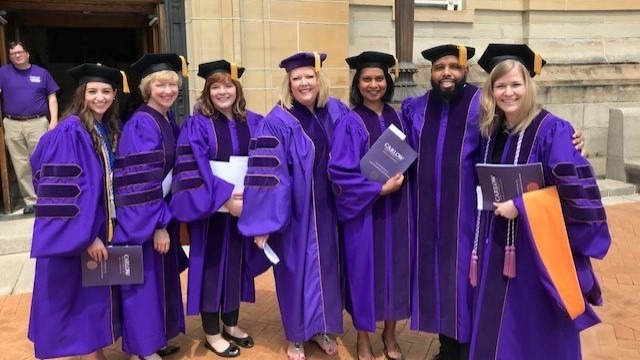
Barron Taylor (second from right) with his DNP cohort
You went on to earn a doctorate from Carlow as well. What did that milestone mean to you?
I eventually went on to pursue my Doctor of Nursing Practice, and when I graduated, I became the first African American male DNP graduate in Carlow’s history.
What is interesting is that I knew years earlier that I wanted to do that. When I graduated with my bachelor’s degree in 2010, the university was celebrating its first doctoral cohort. I remember looking at those graduates and saying to my wife, “I am going to go get one of those gowns.”
From that moment forward I watched every cohort come through the program until the day I walked across the stage myself.
What are you doing professionally today?
Today I serve as a senior educator on the national clinical education team for Humana’s primary care organization. My role is to teach nurse practitioners, physician assistants, and physicians across the country about value-based care and how to transition into that model of medicine.
For me, it is a full circle moment. I am a kid who grew up in very difficult circumstances, and now I am helping educate clinicians across the country.
When I look at my career, I know without hesitation that I would not be where I am today if it were not for Carlow University.