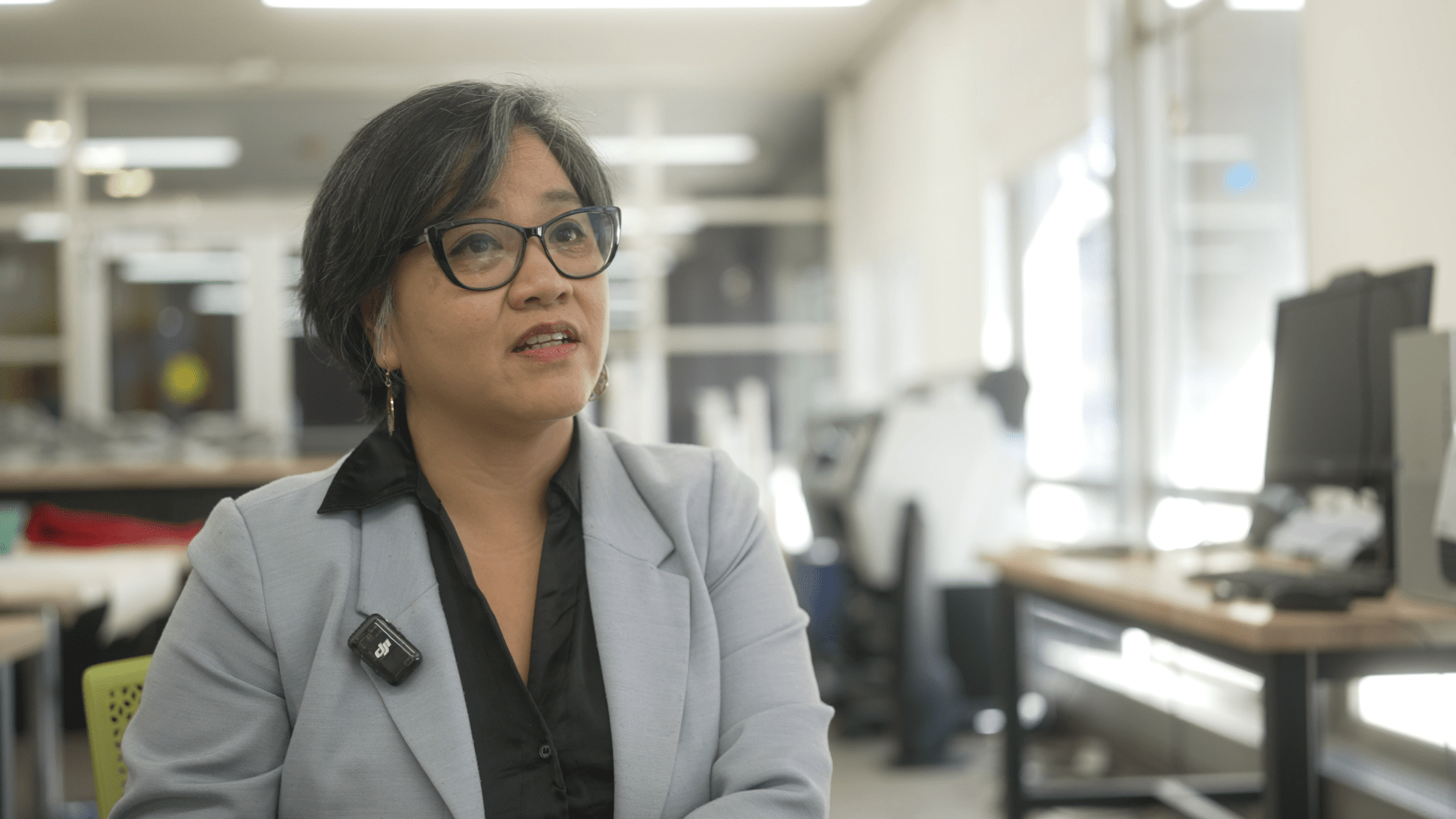
For Fran Flaherty, Assistant Professor of Digital Art and Emerging Media, art is inseparable from care. Her work, which spans disability access, community partnerships, and global collaboration, invites the viewer to reconsider what creativity can do in the world. As Director of Carlow’s Fab Lab, she cultivates a learning environment where technology and human connection work hand in hand, encouraging students to see innovation not as competition, but as a form of compassion.
Through local and international partnerships, Fran gives Carlow students the opportunity to see art as a bridge: between disciplines, between people, and between ways of understanding the world. Her guidance helps them step into an interconnected future with openness and empathy.
We spoke with Fran about the values that shape her work, the role of care in creative practice, and how the Fab Lab prepares students to engage with communities near and far.
The main theme of your scholarship and artistic practice is care. Can you explain a bit about what that means and how that focus developed for you?
My work has always centered on care. I founded an organization called the Anthropology of Motherhood, which brings together artists exploring the culture of care—from motherhood to sustainability, disability justice, and ethics. Before coming to Carlow, I was director of the Dyer Arts Center for the Advancement of Deaf Culture at the National Technical Institute for the Deaf. Across all these roles, the thread that connects everything is care: the need to care for others and the need to be cared for. It’s something I see in people from every background, every generation, every community I’ve been part of. That shared desire is what drives my work.
You mentioned that becoming a parent shifted your artistic priorities. In what way?
After the birth of my first child, everything refocused. I wanted him to grow up in a world where care wasn’t an afterthought, but a value we lived every day. I realized how deeply our society prioritizes competition and acquisition, and how easily we forget that caring for each other is the foundation of our existence. My work became a way to reclaim that—both personally and collectively.
How does that philosophy connect to the students you work with at Carlow?
Carlow students are incredibly generous with who they are. They’re open to ideas that some in the art world might dismiss as too sentimental or too focused on care. Here, I have the freedom to explore that openly because our students embrace it. They want to do work that reflects compassion, service, and justice. Their willingness to embody care in their creative process allows the Fab Lab to be so much more than a makerspace. It becomes a space for ethical and community-centered innovation.
What kinds of opportunities do students get through the Fab Lab?
We try to give students experiences that connect them directly to real communities. For the Pittsburgh Chandelier, six Fab Lab interns worked with me throughout the summer, gaining hands-on experience in community-engaged public art. Because of that project, one of our students is now interning with Riverlife on their public art initiatives. We’ve also built partnerships with the Homewood Y Makerspace and the Frick Environmental Center, where students design community engagement programs through art. People want to collaborate with socially conscious, ethics-driven young people, and our students embody that.
You’ve said you want the Fab Lab to show that innovation can be a tool for care. What does that look like in practice?
Innovation isn’t just about new machines or cutting-edge technology. Accessibility is just as important. Tools are only meaningful when people can use them, teach with them, and connect through them. At Carlow, we stay human-centered even as we introduce emerging technologies. Innovation becomes a way to support people, not replace them. That’s what I want the Fab Lab to model: creativity that advances care, not competition.
Your department collaborates with programs across campus. How does that interdisciplinary work shape students’ experience?
Interdisciplinary collaboration is essential to how we teach. We work with Communications, English, Creative Writing, Practical Nursing, Occupational Therapy, just to name a few. Recently, our students partnered with OT master’s and doctoral students to learn how to better engage artists with intellectual disabilities. These are opportunities students don’t get everywhere. The conversations they have, the people they meet, and the insights they gain shape them into more thoughtful, adaptable creators.
You’re also leading a global exchange project. How does that expand student learning?
We’re working with the College of St. Benilde in Manila, a deaf school, through an online international exchange program. Our students and theirs work on the same projects, comparing approaches, materials, cultural differences, and accessibility needs. Soon we’ll host a shared online critique. Experiences like this deepen students’ understanding of community beyond family, beyond Pittsburgh, beyond the United States. We are becoming a global culture, and this gives them a bridge into that world.