
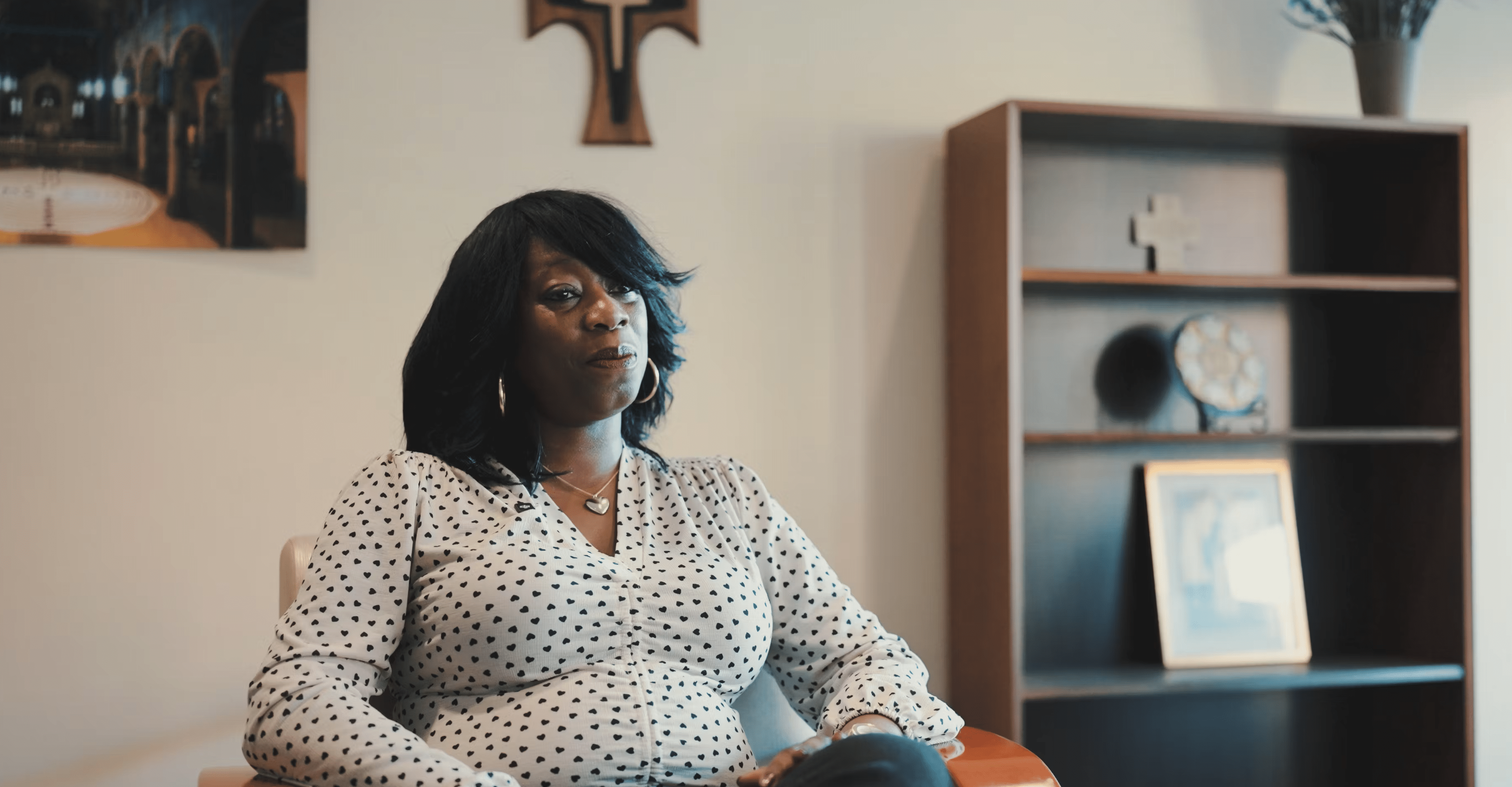
Charita Bush’s voice lights up when she talks about her experience on this year’s Civil Rights Tour, describing it as “a once-in-a-lifetime opportunity.” For Charita, the trip was more than just an educational experience—it was a personal journey that connected with her deeply, both professionally and personally.
When Charita – who goes by the nickname Charlie – first heard about the tour from her professor, she knew it was something she wanted to be part of. The idea of exploring the roots of the Civil Rights Movement resonated with her, especially as an African American woman. “I wanted to go but didn’t know if I could afford it,” she says. But she was able to get the funds together, knowing that this was a chance to expand her understanding of history — and of herself.
An annual tradition at Carlow — despite being preempted by Covid for the previous few years — the tour visits key historical sites and landmarks that have shaped the nation’s ongoing journey toward equality. “You never knew what to expect.” Charlie recalls. “Everywhere we went, there was something that made you feel connected to the past. It was difficult content, but I was excited to hear firsthand accounts from people who were there.”
One of the most moving moments for Charlie was walking across the Edmund Pettus Bridge in Selma, Alabama, a site made infamous by the events of Bloody Sunday in 1965. The group were led by a woman, just a child at the time of the march, who had been there. “She gave us a tour, took us through that day… It was a powerful moment. She had us pick up a pebble from a playground, a place where civil rights leaders like John Lewis met to plan the march.” The symbolism wasn’t lost on Charlie — holding the small stone, she felt a connection to the history that still reverberates today.
Selma, however, left her with mixed emotions. The town, once a battleground for civil rights, now seemed forgotten in many ways. “I feel like even in today’s climate, they’re still being punished for their participation in that march,” Charlie reflects. “There’s no economy, but people are proud of it. It’s their home.” Despite the hardships the town faces, the sense of resilience was palpable.
This deep sense of history has played a pivotal role in Charlie’s academic and professional development. Currently, she is pursuing a degree in Early Childhood Education at Carlow University, where she’s been empowered to follow her passion for working with children. “Carlow has always been close to my heart,” she shares. “I attended a Catholic school near the university as a child, and when this opportunity came up to study here, I knew it was right.”
Carlow’s emphasis on leadership and service has been a perfect match for Charlie’s goals. She has run a childcare facility from her home for years and is pursuing a degree in Early Childhood Education. “As a teenager, I would go on campus to watch basketball games at a Carlow gym, loaned to my school because of space,” she said. “Carlow has always demonstrated a commitment to the community.”
Carlow has supported her as she balances her business with classwork. The university’s commitment to providing a nurturing and accessible learning environment has allowed Charlie to thrive, especially with the flexibility of online courses. “The professors are responsive, and the support I receive is incredible,” she says. “Even though I’m taking classes online, I still feel like I’m part of a community.”
Charlie’s experience on the Civil Rights Tour also reinforced her belief in the importance of education — not just for children, but for society as a whole. “I met so many people on that tour who are still working to preserve history, still fighting for progress. It gives me hope,” she says. One such encounter was with a Freedom Rider, who, despite being in his 80s, continues to share his story and educate future generations. “It was inspiring to see someone who chose to fight for equality.”
Her time at Carlow has only strengthened her resolve to make a difference. “Carlow’s mission is something I see reflected in my own life,” Charita explains. “They focus on creating leaders, and that’s exactly what I want to be.”
As Charita continues her studies and her work with children, she holds close the lessons learned from the Civil Rights Tour — the power of history, the importance of community, and the belief that change is always possible. As she says, “I had to seize this opportunity. And I know I’m better for it.”