
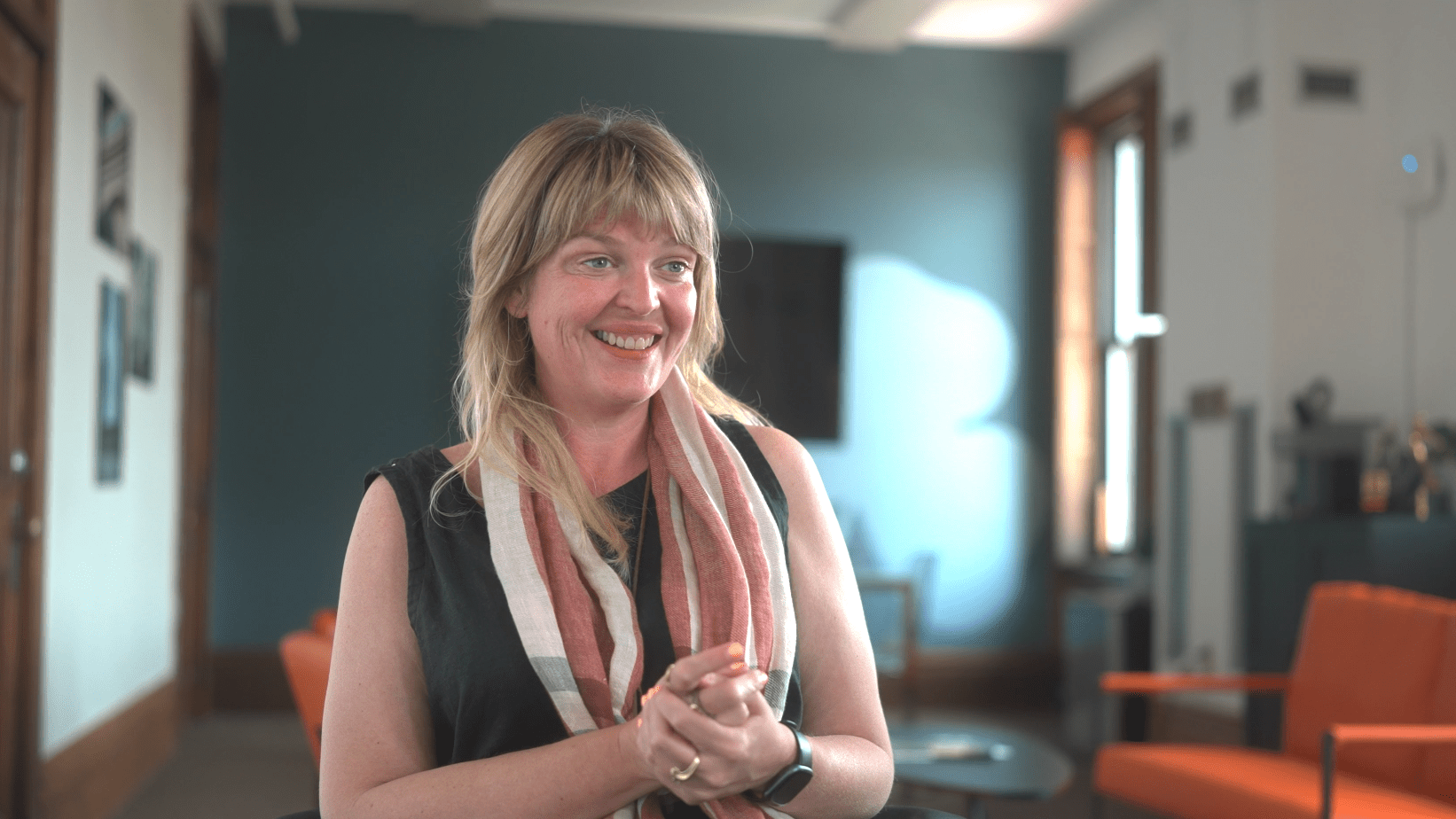
In Sarah Shotland’s classroom, writing is treated as more than an abstract skill. To her, it’s a vehicle for expression. She approaches teaching with the expectation that “in every single classroom, every student is going to have a totally different story,” and making space for those differences is where the real work begins. Her courses become collaborative by design: “Every single class, we become a small team,” she says. “We’re a small family.”
That energy also reflects Sarah’s personality. She’s quick to laugh, down-to-earth, and unapologetically herself (“I’m a garbage can person who is obsessed with Bravo”), while holding high expectations and a clear sense of purpose for herself and her students.
That mix of warmth and introspection is also what defines Sarah’s work beyond the classroom. As director of Madwomen in the Attic, Carlow’s longtime creative writing community for women, she helps sustain and grow a program she describes as “really unique in its combination of rigor and compassion,” where writers can evolve while being challenged and supported. In the Q&A below, Sarah reflects on the legacy of Madwomen, the writers who shape it, and why she believes creative work is ultimately “meant to matter in the world.”
What drew you to Carlow, and what made it the right place for you to teach and create?
I became aware of Carlow because of its literary influence and reputation in Pittsburgh. I had long known about Madwomen in the Attic… and when I had the opportunity to join Carlow, I was thrilled.
You’ve talked about how quickly you felt the depth of the Madwomen legacy here. Was there a moment early on that made that real for you?
[On] my first day at Carlow, the first piece of mail that landed on my desk was a notification that a long-time Madwomen participant had bequeathed her library to our program. it was such a touching and personal gift… [that] and showed me that our program is so meaningful to them, women include it in their last legacy visions for their lives.
For someone who’s never heard of Madwomen in the Attic, how do you explain what it is and where it began?
In 1979, Tilly Olsen, the acclaimed working-class writer, came to visit Carlow… [and] there was a line wrapped around the building of women who were waiting to get in to hear this incredible writer speak. Some women started discussing the fact that they themselves were writers, but they didn’t have anyone to share their work with, and those women are the start of Madwomen in the Attic.
It started with just one class in 1979, and now 45 years later the program has expanded to include almost thirty twelve-week workshops a year. We serve hundreds of women.
What makes the program special, especially for writers who want more than a single class or workshop?
Our program is designed so that people stay with us for decades of their life as a writer. It isn’t about building a single skill. It’s about giving you the holistic support you need to sustain a creative life. We all have to write alone, but we do not have to write lonely. It gives you rigorous challenges in your craft, but it also gives you the kind of relationships that mean you can take a risk in your writing… you can say something that you don’t quite know what you mean yet, and we celebrate each other.
You’ve also described Madwomen as a community that goes beyond the page. What does that look like in real life?
The people who come to these writing workshops come as their entire selves… and it also exists off the page in how they show up for each other. [It’s] a real community of collaborators. I think of the Madwomen as a real meeting of the minds. Every time I leave a session, I feel so much more invigorated and optimistic about my own creative life.
Is there a particular writer or experience in the program that has stayed with you and reminded you why this work matters?
In my first Madwomen workshop that I was facilitating in 2022… the theme was writing the body. And this writer had been diagnosed with ALS the week before class. She’s in her 40s… incredibly vibrant, incredibly healthy, incredibly creative, brilliant woman… and after that night’s class I realized that this is exactly what I’m supposed to be doing with my time.
Hannah Du Plessis wrote a lot about what it’s like to confront a terminal diagnosis in the body… such incredible writing that was incredibly powerful and difficult but also really funny at times. Since then… she’s gone on to join the Carlow MFA in Creative Writing program… and last year Madwomen published her book, it’s called Bedsores and Bliss. That is an experience that I don’t think most writing programs have.
Carlow’s mission is rooted in mercy. How do you see that value show up through writing and creative work?
If we define mercy as walking through someone else’s chaos, as going to the places in our culture that are the most violent, the most isolated, the most misunderstood. That is how writers are able to walk with people through their chaos. If you’re a person who believes that art has the power to do more than self-generate or self-congratulate, you have to be able to walk with someone through their story and hear it and hold it.
If you think art has the power to actually make a difference in the real world, come here [to Carlow]. We don’t make art for art’s sake. We make art that is meant to matter in the world.