
At Carlow University, accessibility is part of who we are. We believe every student should have the opportunity to learn, participate, and thrive in a supportive, inclusive community. The Disability Services Office is here to partner with you. We offer personalized support designed around your individual strengths, needs, and goals, because no two student experiences are exactly the same. If you are considering accommodations, we want you to know that the process is collaborative, thoughtful, and confidential. We take the time to understand your situation, review documentation carefully, and work with you to identify reasonable accommodations that promote access and full participation in your Carlow experience. Our goal is to make the process feel clear, respectful, and welcoming from the very beginning. Whether you are a new student, a current student, or simply exploring your options, we invite you to connect with us and learn how we can support your Carlow experience.
Requesting accommodations through the Disability Services Office is a collaborative, three-step process. We encourage new students to begin as soon as they are enrolled so support can be in place as early as possible. We’re here for you every step of the way.

This form gives DSO staff information about your disability and how it impacts your academic experience and campus life.

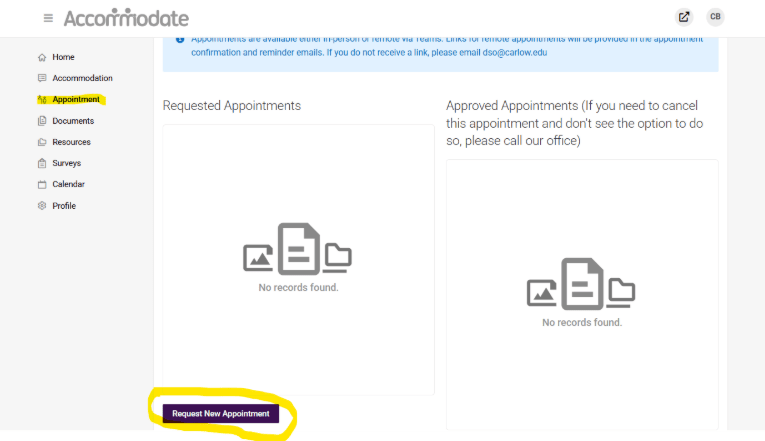
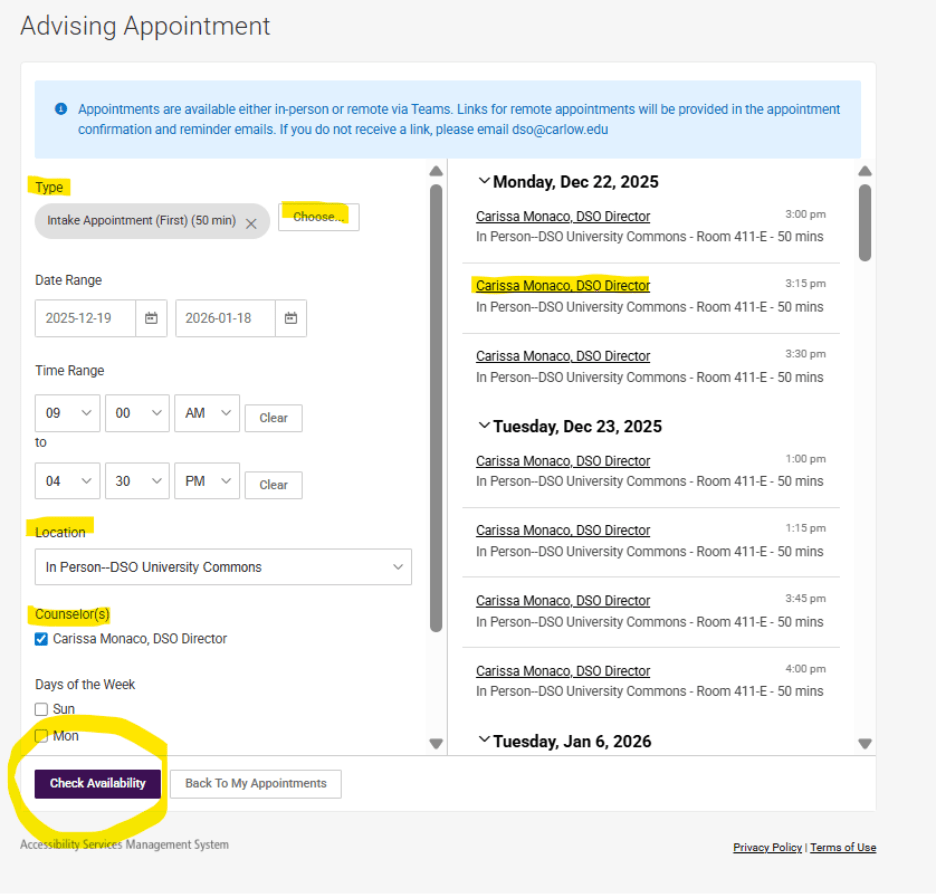
Once your request and documentation have been reviewed, you will receive a notification with instructions on how to set your appointment.
During the intake process, you and DSO staff will discuss your documentation, your perspective on how your disability affects you, and the accommodations you are requesting.
Seeking accommodations is a proactive step toward your success at Carlow University. Below you will find helpful resources.
Carlow University makes every reasonable effort to provide qualified applicants and students with disabilities with the opportunity to take full advantage of its programs, activities, services and facilities. The Disability Services Office (DSO) supports this commitment by arranging reasonable accommodations tailored to individual needs.
When students seek accommodations, the Disability Services Office must determine 1) if the student’s physical or mental health condition qualifies as a disability, 2) the barriers and impacts the student experiences related to the disability, and 3) the level and severity of the impacts.
Documentation is only one part of the interactive process during which accommodations will be determined. DSO staff will work with students to determine individualized accommodations using both documentation and insight shared by the student during the Intake Interview.
Criteria for the source, scope and content of documentation differs by disability type. The below information is intended to provide students with a starting point for obtaining adequate documentation.
Disability Services does not perform psychological or neuropsychological evaluations. If you are having difficulty obtaining documentation or connecting with a provider, please contact us at DSO@carlow.edu. We may be able to refer you for an assessment through our campus resources at no cost to you.
The following assistive technology is available for our students.
You can easily convert documents to an alternative, accessible format with SensusAccess. The use of SensusAccess requires a “carlow.edu” email address. If you need help, watch this video.
Carlow University references several sources in making adjustments to provide for the needs of students with disabilities. They include:
The purpose of the disability accommodation process is to ensure a student is not discriminated against solely on the basis of disability and has the same level of access to Carlow University as their nondisabled peers. The goal is equal access and equal opportunity, not to facilitate a specific accommodation.
Of note, accommodations in K–12 environments may reduce standards and expectations to promote academic success because success is central to the K–12 accommodation process. In college, the process is substantially different. The fundamental baseline of college accommodations is equal access and opportunity relative to other students.
The Disability Services Office facilitates an interactive process to understand a student’s academic and/or housing experiences and how any accommodations requested may be necessary to ensure nondiscrimination and equal access and opportunity. The goal is to remove an institutional barrier created by the college environment. Every request for accommodation is explored on an individualized, case-by-case basis in which facts and relevant information are gathered. The process may be brief or involve a series of communication exchanges, depending on the nature of the request.
Documentation serves two purposes:
While third-party documentation may confirm the existence of a disability, it does not solely determine the reasonableness of accommodations. Medical information is taken into account, but it is not the sole factor in our decision-making process. Disability Services considers multiple elements when evaluating accommodation requests.
Recommendations made by medical providers are not automatically approved, as they may exceed what is necessary for ensuring equal access. When suggested accommodations are aimed primarily at enhancing academic performance rather than addressing barriers to access, students may be referred to other campus resources or provided with alternative options to meet their needs.
For more information, please review the Disability Services Documentation Guidelines.
Disability Services prioritizes equity and strives to facilitate accommodations that offer the most equitable experience without fundamentally altering an essential outcome or aspect of a course or campus experience. Students with disabilities meet the same academic standards and essential course objectives as every other student. Furthermore, the overall expectations of being a college student, as required of all students at Carlow University, are not to be reduced.
The interactive process may include consultation with faculty and others to ensure reasonable access is facilitated, which may occur through accommodations or other measures, such as inclusive design.
Disability Services utilizes a structured review process for each accommodation request. A reconsideration process is available for students who do not agree with the initial determination. For more information, please see the Accommodation Appeal Process and Procedures on the Disability Services website.
When necessary, reasonable accommodations are provided when they:
Requested accommodations will not be supported for disability reasons or within the context of a specific academic experience if the accommodation would result in any of the following:
At times, an accommodation may be deemed appropriate for disability reasons but is not reasonable within the context of a specific academic experience after further analysis due to one or more of the above-listed factors. In these situations, Disability Services will attempt to identify alternative reasonable accommodations, if possible.
A housing accommodation due to disability is generally not supported for any of the following reasons:
At times, an accommodation may be deemed appropriate for disability reasons but is not reasonable within the context of a specific housing experience after further analysis and/or discussion with Housing. In these situations, Disability Services will attempt to identify alternative reasonable accommodations, if possible.
A requested accommodation may be unreasonable if:
Carlow University is committed to creating and sustaining a successful community of inclusive excellence as we prepare students to live, learn, and work among people who experience the world in fundamentally different ways. Within this framework, the University is committed to providing a supportive environment for students with disabilities as well as to complying with all applicable provisions of the Americans with Disabilities Act as amended (ADA), Section 504 of the Rehabilitation Act of 1973, and the Fair Housing Act.
Service animals are animals trained to do specific work or tasks to assist people with disabilities in the activities of daily life. Under the ADA, service animals are allowed to accompany people with disabilities in all areas where a student is normally allowed to go. Emotional Support Animals are animals that may be needed because of a disability, but are without specified training to assist with the activities of daily life. An Emotional Support Animal is not considered a service animal under the ADA These animals that provide support but do not have specialized training may be identified by various names i.e., a companion animal, Emotional Support Animal, therapy animal or assistance animal. Carlow University uses the term Emotional Support Animal (ESA). ESAs, unlike service animals, have additional restrictions regarding where they can be utilized.
Under the Fair Housing Act (FHA) a person with a disability may keep an ESA in the individual’s dwelling when there is an established need for the therapeutic nature of the animal that is connected to the individual’s disability. An ESA provides emotional support to persons with disabilities who have a disability-related need for such support. The ESA is indicated by an appropriate and relevant healthcare professional as necessary for an individual with a disability.
An ESA may be a reasonable accommodation for a student with disabilities but only within the student’s privately assigned living space. Students may qualify for this accommodation if (1) the student has a documented disability; (2) the animal is necessary to afford the student with a disability an equal opportunity to use and enjoy their dwelling; and (3) there is an identifiable and documented nexus between the disability and the assistance that the animal provides. The University will allow only those ESA’s that are allowed by local and state laws and conform to standards within this policy.
Students must receive Emotional Support Animal designation from the Director of Disabilities Services Office (hereto referred to as “Director”) prior to bringing their animal to campus. A student requesting permission to keep an Emotional Support Animal in University housing must make a formal request to the Disability Services Office. To do so, the student must submit the appropriate “Disability Housing Accommodation Request Form” and, in some cases, documentation of his/her disability for review. Forms must be completed and submitted as soon as a student knows that he/she will be requesting a Service or Emotional Support Animal, which should be at least 30 days before the student intends to move into University housing.
While applications submitted after this timeframe may be accepted and considered, the University cannot guarantee that it will be able to meet a late applicant’s accommodation needs, including any needs that develop during the semester. Therefore, students are to follow the deadlines indicated for all housing accommodations requests found in the general Housing and Food Service Accommodation policy.
To make determinations, the Director will review documentation, and communicate/consult with the appropriate members of the university community. Like all accommodations, the determination of whether or not an ESA shall be permitted is made on a case-by-case basis through an interactive process between the student and the Director. Once approved, the Director will notify the Residence Life Office, and the student. A Residential Life staff member will likely then contact the student for additional details and, along with the student’s other residential life preferences or needs, determine a housing option for the student. Students should note that housing options may be limited as the University balances appropriate accommodations to students with disabilities with students who have allergies and/or animal fears. Consequently, advance notice as noted in the Housing and Food Service Accommodations policy of the need for an animal is essential to the University providing a smooth transition for the student and the rest of the community where the student will reside.
The care and supervision of the ESA is solely the responsibility of the student owner. The student must be in full control of the ESA at all times. ESAs may not pose a direct threat to the health and safety of persons on the University campus, cause physical damage to property, or fundamentally alter the nature of the University operations. The ESA must be maintained (kept clean, free from fleas or ticks, etc.) and may not create safety hazards for other people. Local and state ordinances and laws regarding animals apply, including requirements for immunizations, licensing, noise, restraint, at-large animals and dangerous animals.
An animal’s behavior, noise, odor and waste must not exceed reasonable standards for a well-behaved animal. These factors should not create unreasonable disruptions for other residents. If the noise (whining, barking or meowing) is excessive, it is grounds to remove the ESA from campus. ESA’s may also be excluded from the university campus if the animal behaves in an unacceptable way or the student does not control the ESA. Uncontrolled barking, jumping on other people, or running away from the handler are some examples of unacceptable behavior for an ESA.
Any suspected or observed issues related to animal abuse or neglect will be reported to the proper investigatory authorities and may subject the student to University disciplinary action as well.
The student is responsible for immediately cleaning up and properly disposing of the ESA’s waste and is responsible for having the equipment to do so. Generally, this task cannot be delegated to another if the owner is physically able to accomplish this task. People who are physically unable to accomplish this task are responsible for arranging for it to be done and any related costs. The University retains the right to designate a particular area for the ESA to relieve itself and/or for the disposal of its waste.
ESAs are limited to the privately assigned living space (room) of the student except when exiting or entering the student’s residential building. The animal may not be taken into bathrooms, laundry facilities, indoor recreational rooms, lounges, hallways, computer labs, study rooms, or other areas of the residence hall. It also cannot be taken into classrooms or other buildings on campus or allowed to roam freely on campus grounds.
ESA’s must have enough space within the privately assigned living space to be appropriate to the size of that animal. ESAs are to be confined (i.e. cage, tank) when the owner is not present in the room. Owners shall not leave their ESA unattended overnight. The animal may not be left under the care of others on campus. If the owner cannot take the animal with them, the animal must be taken off campus until the owner returns.
Roommates, neighbors, security, physical plant, grounds crew, housekeepers, on-call staff, and residential life staff may all be notified of the presence of the approved ESA in a particular space.
The student, not the University, is responsible for the actions of the ESA including, but not limited to, any bodily injury or property damage. Students with ESAs shall be charged if additional cleaning or damage occurs as a result of having the animal on campus. The student is expected to pay these costs upon repair or cleaning. In addition, the University retains the right to remove the ESA, at the owner’s expense, should the animal become a direct threat to the health and safety of others or violates these requirements in any way. The owner must provide the name and contact information of an off-campus person who is willing and able to take the animal in the event of an emergency.
The student must sign an Assistance Animal Agreement prior to bringing the ESA to campus.

Carissa M. Monaco
Director, Disability Services & Title IX Coordinator
We’re here to help you through the accommodations process.